
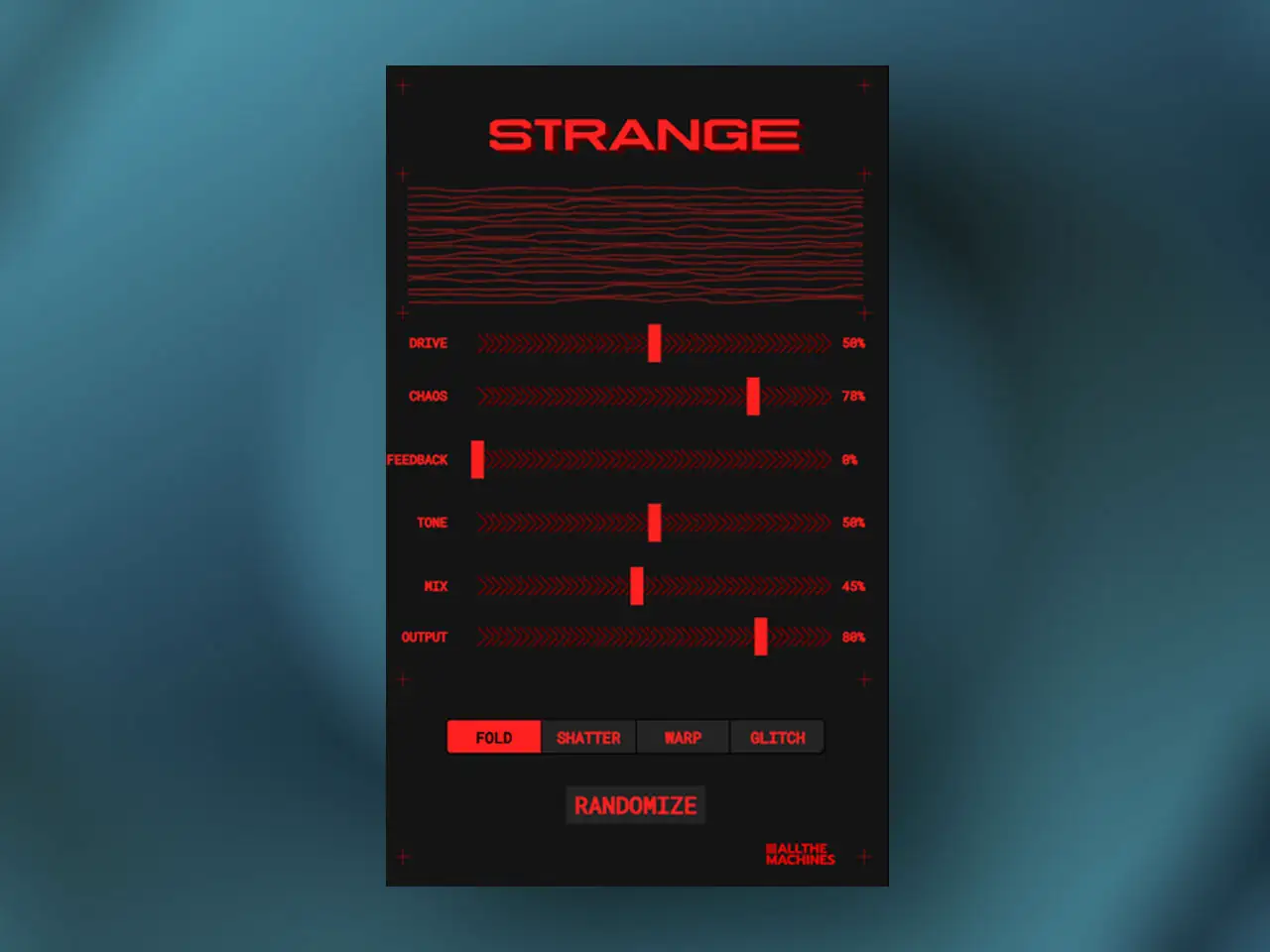
Stephan Bolch has released Strange – Chaos Distortion, a departure from conventional waveshapers that uses living mathematics rather than a fixed transfer curve. Instead of clipping your signal at a static point, Strange feeds it into Lorenz and Logistic chaos systems — attractors that never repeat the same path twice — so the distortion evolves with every pass. Drive the chaos harder and it warps deeper. Pull back and it colors. The curve is never the same twice. Community reaction on release day put it plainly: you can go from the subtlest grain to full audio destruction within the same plugin, with the character shifting as you push the system.
The control architecture centers on Drive, which determines how deep your signal enters the chaos system from subtle coloring to full saturation, and Chaos, which adjusts the density and intensity of the chaotic attractor. Higher Chaos values produce wild, unpredictable distortion that breaks from the expected harmonic profile of a standard waveshaper. Feedback is where the behavior gets most interesting: routing the output back into the chaos system adds resonance and self-oscillating character. Four modes define the character of the chaos itself — Fold produces wavefolding-style rich harmonic overtones, Shatter breaks the signal into quantized chaotic fragments for industrial or lo-fi textures, Warp produces liquid-like frequency shifts and domain warping, and Glitch displaces blocks of audio based on the chaos engine’s state for rhythmic, stuttery effects. Tone handles post-distortion frequency shaping and a dry/wet Mix control opens up parallel processing. As an AUv3 plugin it runs inside AUM and Loopy Pro with multiple independent instances.
Strange was released alongside Drift — Bolch’s more controlled shifting saturation plugin — and the two cover different territories. Drift steers its movement; Strange doesn’t. The mathematical chaos in Strange means the distortion is inherently non-deterministic, which makes it suited to texture work, evolving pads, sound design on static sources like drums or synth chords, and anywhere you want the saturation to feel like it is breathing rather than processing. The interface works on all modern iPhone and iPad screen sizes. Minimum iOS 14.0, no in-app purchases.
Key features:
- Chaos-Based Distortion Engine: Uses Lorenz and Logistic attractors — mathematical systems that never repeat — as the distortion curve
- Drive: From subtle coloring to full saturation as your signal enters the chaos system
- Chaos: Adjusts the density and intensity of the attractor — higher values produce wild, unpredictable distortion
- Feedback: Routes output back into the chaos system for resonance and self-oscillating character
- Four Modes: Fold (wavefolding harmonic overtones), Shatter (quantized scatter), Warp (domain warp / liquid saturation), Glitch (block displacement for rhythmic stuttering)
- Tone: Post-distortion tonal shaping to sculpt frequency content after the chaos
- Mix: Full wet for pure chaos, blended back for parallel processing
- AUv3 Plugin: Multiple independent instances in AUM, ApeMatrix, Audiobus, or any AUv3 host
- Universal on iPhone and iPad, all modern screen sizes — minimum iOS 14.0
App price: $1.99
No in-app purchases.
Original release: May 8, 2026 | Latest update: May 8, 2026


