
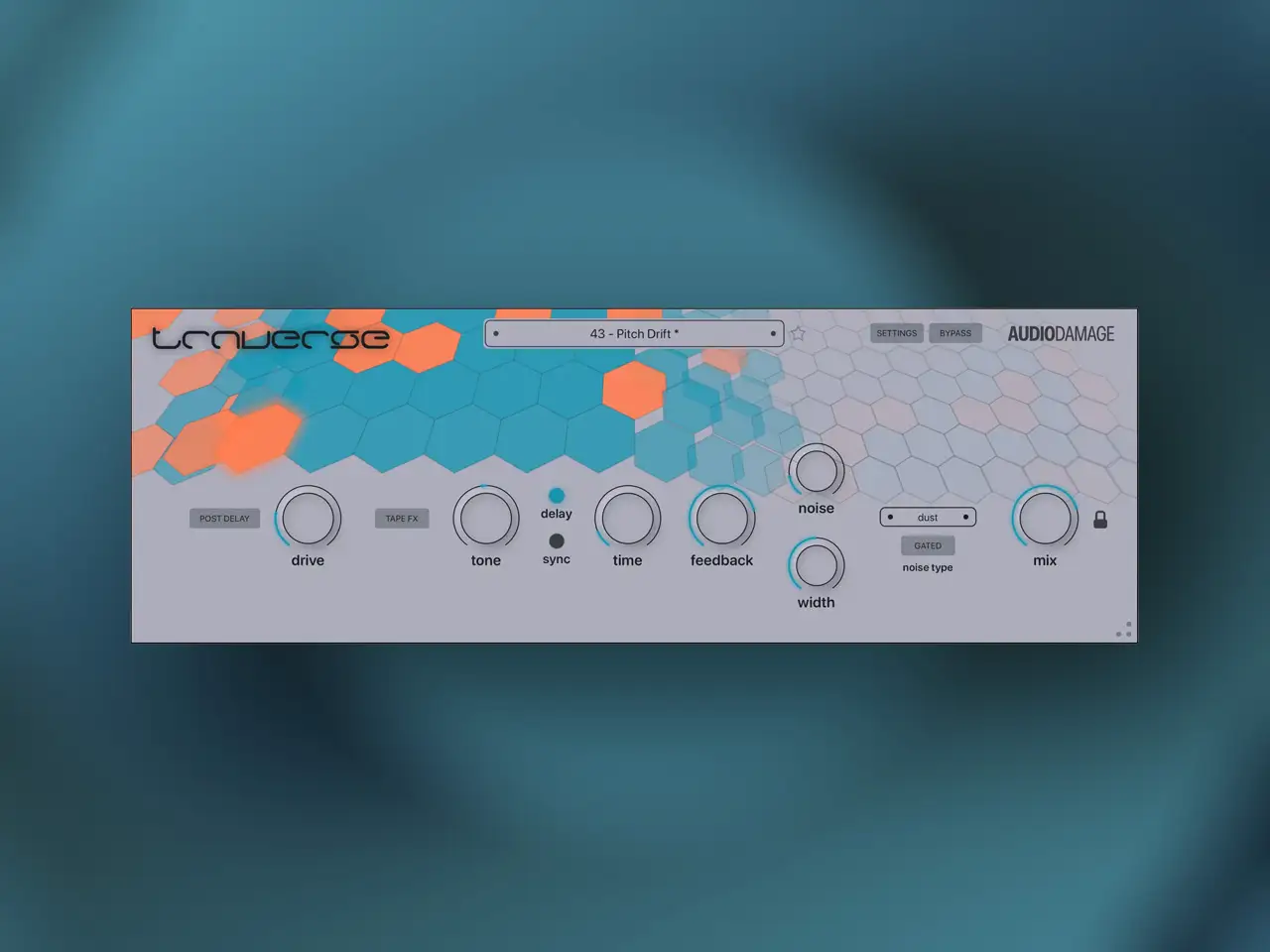
Audio Damage has a specific knack for releasing tools that do one thing and do it properly. Traverse, the newest addition to their Motion Effects lineup alongside Ascent and Descent, fits exactly that pattern. It pairs a cassette tape emulation engine with a stereo tape delay in a single plugin, and the combination turns out to be more than the sum of its parts. There are plenty of lo-fi processors on the App Store right now. Most of them apply a static frequency curve and call it tape. Traverse is not doing that. The cassette engine is built on a magnetic-hysteresis model — a state-dependent nonlinearity that responds to signal history the way real tape oxide does, producing harmonically rich saturation that changes depending on how hard you push it. That is the difference you hear immediately when you sweep the Drive control. The output level stays steady throughout that sweep, which is good engineering and saves you from constant gain-riding.
The wow and flutter section deserves attention because it is handled with more care than most competing apps bother with. Both are driven by independent LFOs with layered noise components rather than a single shared modulation source, which is why the stereo pitch instability sounds organic rather than mechanical. Push both simultaneously on a pad or a slow vocal sample and the stereo image starts to breathe on its own. It is subtle at low settings — almost subliminal — but it changes the feel of whatever it touches. The nine procedural noise profiles are similarly well-considered. Hiss and dust are the obvious choices, but the Califone Card Reader option adds a specific kind of worn institutional texture that is hard to find elsewhere on iOS. Routing all of that noise directly into the cassette path rather than mixing it in at the output means the saturation and EQ actually color the noise itself, so it blends into the signal convincingly rather than sitting on top of it.
The routing toggle is the most practical design decision in the whole plugin. Off puts the cassette engine first, feeding every echo repeat back through the saturation, wow, and flutter — so the delay tail degrades with each pass the way a Space Echo does. Repeats bloom and dissolve. On runs the clean signal straight to the delay and applies the cassette character only to the tail, which keeps the dry signal intact while the echoes decay into texture. Both modes are genuinely useful and suit different production contexts. For ambient, dub and lo-fi work, the Space Echo routing is the obvious choice. For anything where you need the dry signal to stay clean — a lead synth, a vocal — the alternative routing gives you character without smearing the source. Loaded as an AUv3 inside AUM, parameter recall is instant and the CPU overhead is minimal even with multiple instances running. In Cubasis 3, it loads on any audio track without configuration and the host-tempo delay sync works reliably from the first bar.
Traverse is a character tool, not a modulation powerhouse.
The honest limitation here is scope. Traverse is a character tool, not a modulation powerhouse. If you want complex internal routing, a deep modulation matrix, or multi-band processing, this is not the plugin for that. The tape splice simulator — four controls for event rate, depth, pitch-chirp, and amplitude-dip — adds procedural dropouts convincingly, but there is no way to sequence or sync those events to your host. That might matter in some workflows. For most producers using this on drums, synth pads, or ambient loops, it will not come up. At $2.99 introductory price, the question of whether to buy is not really a question. This is Audio Damage quality at a price that makes it easy to just have in your toolkit permanently.
Key features:
- Magnetic-Hysteresis Cassette Engine: State-dependent nonlinearity model wrapped between pre-emphasis and de-emphasis filters, replicating how real tape oxide saturates under signal history
- Independent Wow and Flutter: Dual LFO-driven modulation with layered noise components and per-channel stereo movement for natural pitch instability
- Flexible Routing Toggle: Switch between a Space Echo model (cassette before delay, degrading feedback loops) and a clean-input mode that applies cassette character only to the delay tail
- Stereo Tape Delay: 20ms to 10 seconds range, host-tempo sync, and ping-pong width control
- Procedural Tape Splice Simulator: Four controls managing event rate, depth, pitch-chirp, and amplitude-dip to emulate dropouts and worn tape mechanics
- Nine Noise Profiles: Hiss, Dust, 50Hz/60Hz Hum, Fan Rumble, Califone Card Reader, and more — routed into the cassette path so the noise itself is colored by saturation and EQ
- Bipolar Tone Control: Single-knob tilt EQ inside the cassette signal flow for fast dark/bright balance adjustments
- Internal Gain Compensation: Output level stays consistent across the full Drive sweep
- Universal AUv3 and standalone on iPhone and iPad
App price: $2.99 (introductory launch pricing).
No in-app purchases. No subscription.
Original release: May 28, 2026 | Latest update: May 28, 2026 (v1.0.0)


