
Quantovox — the developer behind Voxomat and RealPhase — has released Melthaven, a note-triggered phase shifter for iOS that addresses a specific problem with the standard LFO-driven phaser: the LFO doesn’t know what you are playing. It runs at its fixed rate whether you are playing fast staccato lines, holding a long sustained chord, or sitting in silence. The modulation and the performance are disconnected by design. Melthaven replaces the free-running LFO with a custom transient detection algorithm paired with a dedicated envelope generator. Every note attack resets and shapes the phase sweep based on that specific transient — your playing becomes the engine of the effect rather than a performance that has to fit around it. Released May 14, 2026, $2.99 with a Pro Edition IAP for expanded features.
How the Note Detection Actually Works
This is worth explaining carefully because the implementation separates Melthaven from what most producers will assume is a standard envelope filter. An envelope filter — auto-wah — responds to amplitude: when the signal gets loud enough it opens a filter, when it drops the filter closes. That works well for strummed chords and single note lines where each note has a clear volume drop between it and the next. It breaks down for fast ghost notes, muted strings, percussive slaps, and any situation where the overall signal level stays consistent but individual articulations are still happening within that envelope.
Melthaven uses statistical signal processing rather than a simple amplitude threshold. The algorithm tracks transients and can detect articulations that occur under a consistent signal amplitude — what the developer calls “hidden notes.” A bassist playing quick ghost notes under a steady sustain, or a guitarist doing rapid picking without the note volume dropping to zero between attacks, will get each articulation tracked and re-triggered accurately. This is also why Melthaven sounds different from an envelope filter even on simple inputs: it’s doing phase shifting rather than filter cutoff sweeping, which produces analog-modeled OTA filter resonance and formant-like character that envelope filters don’t generate.
What Different Sources Sound Like
Quantovox designed Melthaven with electric guitar and bass as the primary targets, and the plugin is explicitly tuned to the frequency response and transient peaks of those instruments. A pick attack or a slap pop gives the transient detection exactly what it needs — sharp, defined, unambiguous. On saturated or overdriven guitar tones, the harmonic density of the signal pushes the phase shifter into growling, vowel-like sweeps that track the performance rhythm. On clean bass, the same trigger mechanism produces a tighter, bubbling character. Fast staccato picking gives you rapid, slappy phase textures. Holding a long overdriven chord gives you a deep, slow sweep that builds across the sustain. The effect adapts because the trigger adapts.
Synth basses with sharp attacks and fast decays work similarly — the transient is clear and the re-trigger is accurate. Where it gets more interesting is with softer, more processed material. Feed Melthaven a slowly evolving pad or heavily processed audio and the detection becomes uncertain. The effect produces wild, unpredictable responses because the algorithm is finding triggers that weren’t intended. The dedicated Smoothing control is the key to this territory: it shapes the envelope to produce a weighted, fluid response, turning unpredictable re-triggers into something that feels organic rather than glitchy. At high smoothing values on ambient pads it becomes an experimental modulation tool. The developer explicitly notes the plugin is not optimized for upright acoustic bass, where the softer, less defined transients don’t give the detector enough to work with.
AUv3 Integration and Controls
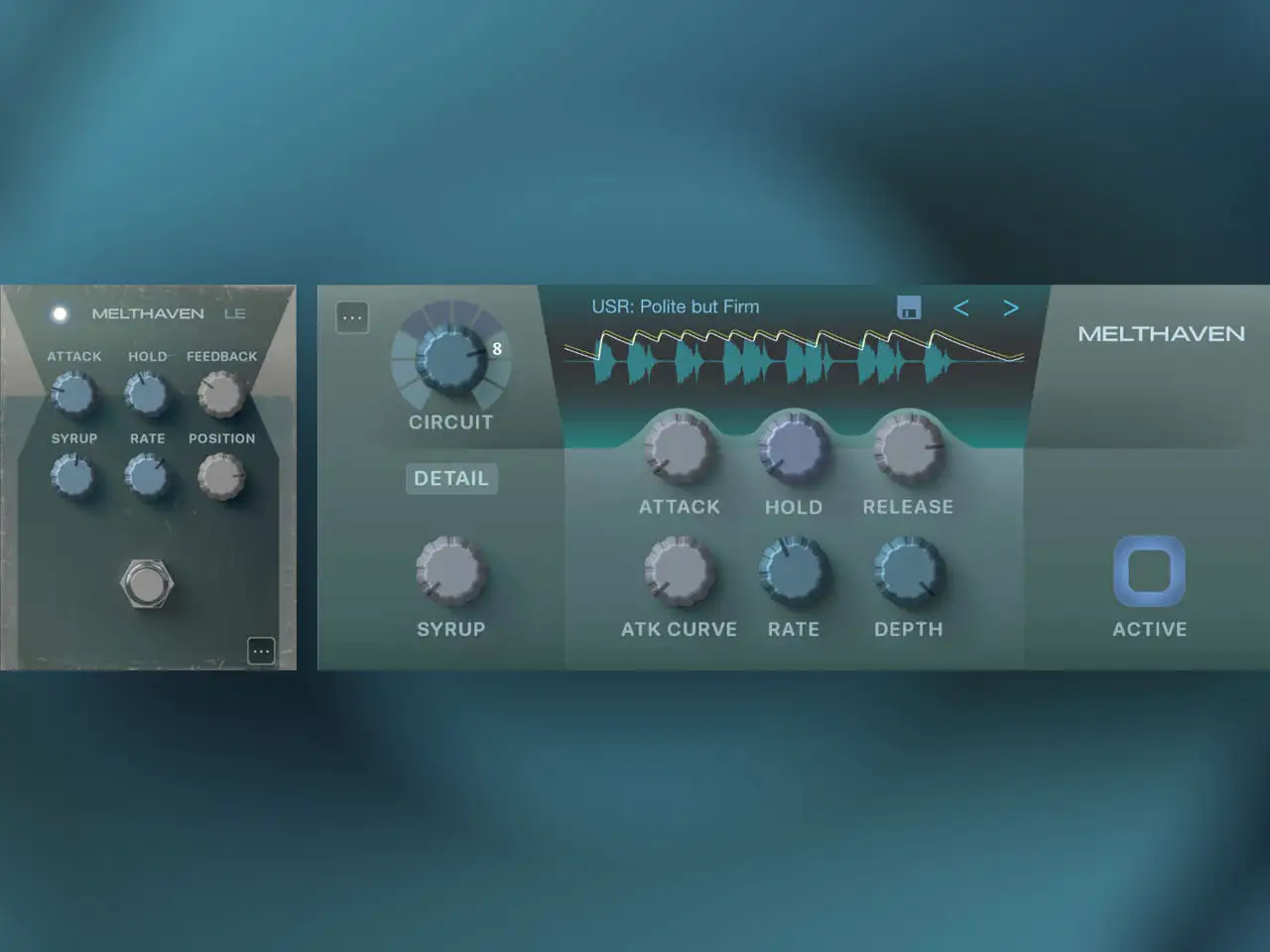
In AUM it inserts cleanly on any signal chain with the standard AUv3 interface. Stack it after a bass synth from the instrument chain and the phase shifting tracks whatever the sequencer plays in. In Loopy Pro, running it live on a looped guitar part makes each pass through the loop slightly different because the envelope response varies with the exact timing and intensity of each attack. The UI is touchscreen-friendly and deliberately focused — no deep menu structures. Core controls are Feedback, Panoramic Position, Attack and Hold timings, Smoothing, and an LFO Rate for blending triggered envelope behavior with underlying continuous modulation when you want a hybrid of both approaches.
Placement matters for the character. Before an amp simulator, Melthaven integrates subtly into the overall tone — the phase shifting feels like part of the instrument rather than an effect on top of it. After heavy saturation, the high harmonic density the distortion generates interacts with the phase resonance to produce more aggressive, tearing sweeps. Both positions are valid and produce very different results from the same source material, which expands the useful range of the plugin considerably.
Pricing and the Pro Upgrade
The base version is $2.99 — one of the lowest price points for a genuinely distinct effect concept on the App Store this year. A Pro Edition Upgrade is available as a $4.99 one-time in-app purchase . The developer’s previous app Voxomat we covered earlier this year and it has held up well in the community, which gives Melthaven a credible starting point. iOS 17.0 or iPadOS 17.0 required. AUv3-compatible host required to use the plugin — standalone is only for registration.
Key features:
- Note-Triggered Phase Shifting: Custom transient detection algorithm and envelope generator re-trigger the phase sweep on every note attack — your performance rhythm drives the effect
- Statistical Note Detection: Tracks “hidden” notes under consistent signal amplitude — fast ghost notes and rapid articulations register accurately without volume-drop triggers
- Analog-Modeled OTA Filters: Deep resonance and formant-like character distinct from envelope filter frequency sweeps
- Smoothing Control: Shapes envelope response for softer/processed sources — tames unpredictable re-triggers into organic, fluid movement
- LFO Rate: Blend note-triggered envelope behavior with continuous underlying modulation for hybrid response
- Feedback and Panoramic Position: Core phase character and stereo placement controls
- Attack and Hold Timing: Shape the envelope attack and sustain of the triggered sweep per note
- Optimized for Guitar and Bass: Tuned to the frequency response and transient peaks of electric instruments — not recommended for upright acoustic bass
- AUv3 plugin for iPhone and iPad — iOS/iPadOS 17.0+ required. Standalone is for plugin registration only
Pro Features:
- Additional envelope parameters, several envelope flavors with pre-mapped control subsets
- Pro presets encompassing both strong and milder effects, including the quintessential rubber bass
- Enhanced stereo phaser modes & internal stereo re-imaging modulator (for formant-like effects and more)
- Vintage-style phaser feedback that can optionally build or ramp with each note onset (non-rampable in the base version)
- Instant visual feedback via an audio scope with dual-channel envelopes overlaid on the input waveform
App price: $2.99.
In-app purchases: $4.99 – Pro Edition Upgrade — one-time
Original release: May 14, 2026 | Latest update: May 14, 2026


