
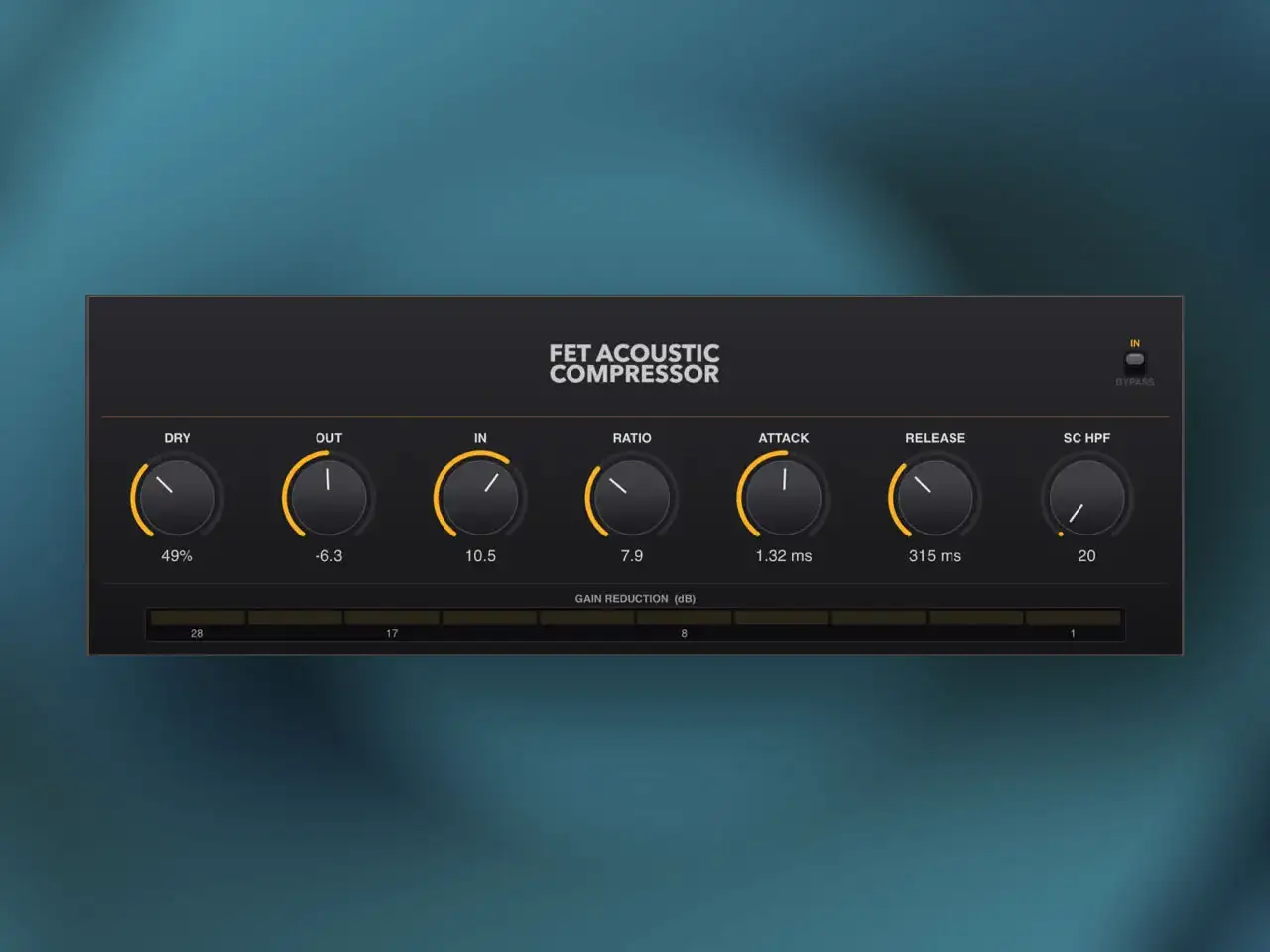
Independent developer Shelbybark LLC has released the FET Acoustic Compressor, a $5.99 AUv3 plugin that brings a specific and recognizable analog compression character to iOS. The circuit inspiration is the vintage 1176 family — the same lineage that produced the Origin Effects Cali76 pedal — and the plugin is voiced for musical, character-forward compression rather than transparent dynamic control. A macOS version is confirmed to be in development. iOS and iPadOS support is available now.
Why “Acoustic” — and Why That Name Undersells It
The “acoustic” designation reflects where the default voicing was calibrated: the complex transients and wide dynamic swings of acoustic guitar, which are among the most difficult material to compress without making the instrument sound pinched or lifeless. Acoustic guitars have fast attack transients from the pick, a complex mid-frequency body resonance, and a sustain that’s sensitive to over-compression. Getting a compressor to tame the peaks without crushing the tone requires a specific combination of soft-knee behavior, program-dependent release, and saturation character that works with the harmonic content rather than against it.
The FET Acoustic Compressor addresses this with three core design choices. A soft knee means compression eases in gradually rather than snapping shut the moment the signal crosses the threshold — the transition between uncompressed and compressed signal is smooth enough that the acoustic body resonance retains its natural character. Program-dependent release means the plugin reads the material and adjusts recovery time accordingly: fast percussive strums recover quickly so the next transient hits with full energy, while long sustained chords ring out without artificial pumping as the compressor holds back and lets the tail breathe. FET saturation adds a warm, subtle harmonic distortion that makes the processed signal feel like it was tracked through analog hardware rather than processed by an algorithm — the kind of coloration that makes a dry, clean digital recording sit more naturally in a mix.
Because all three of those characteristics are broadly musical rather than source-specific, the plugin works well beyond acoustic guitar. Early users in the Loopy Pro community are reporting strong results on electric guitar, bass, vocals, and keyboards — anywhere the 1176 character historically shines. In AUM it drops into any insert slot with the standard AUv3 parameter exposure. In Loopy Pro it works both on individual tracks and as a master bus insert for gluing a full session together before export.
The All-In Mode: A Hardware Trick in Software
One of the most distinctive features of the original Urei 1176 hardware compressor was what engineers called the “All-Buttons-In” trick. The original design had four separate ratio buttons (4:1, 8:1, 12:1, 20:1) that were mechanically exclusive — pressing one released the others. Engineers discovered that jamming all four buttons simultaneously forced the circuit into an undefined state that produced a brutal, heavily saturated compression character at an effective ratio around 100:1, with a characteristic slamming attack and a pumping release that became iconic on drum rooms and rock vocals. It’s heard on more classic recordings than most people realize — the compressed drum sound on countless 1970s rock records went through exactly that trick.
Shelbybark has recreated this in FET Acoustic Compressor with a single tap on the RATIO label in the UI. Activate All-In mode and the ratio locks to 100:1, the soft knee tightens aggressively, and asymmetric FET saturation increases substantially. The character shifts completely — from musical and transparent to slamming and saturated. Used on a parallel drum bus at moderate wet/dry mix, it adds the kind of smashed, glued compression that makes drum rooms sound massive without destroying the transient peaks. Used on a rock vocal bus at lower mix levels, it adds aggressive forward energy without sounding like a limiter. It is genuinely a different tool than the standard mode rather than just a ratio change, because the saturation characteristic changes alongside the compression behavior.
Practical Notes: Where to Use It
The soft-knee standard mode is the right choice for any source where you want compression to feel invisible or gently enhancing: acoustic instruments, clean vocals, bass, keys, and as a final glue stage on a stereo mix bus. The program-dependent release means you don’t have to obsess over finding the right release time setting for different material — it adapts, which is particularly useful on mobile where you often want to move fast rather than dial in parameters carefully. The All-In mode is better treated as a parallel tool in most cases rather than full wet: send the drum bus or a vocal through it at 30-50 percent mix and let the clean signal maintain the transients while the saturated signal adds thickness and aggression underneath.
In Logic Pro for iPad, duplicate a track, insert FET Acoustic Compressor in All-In mode on the duplicate, and mix the two — that’s parallel compression without a dedicated parallel bus setup. In AUM the routing flexibility makes this even simpler to configure. For producers who record live instruments into iOS and find the result sounds too clean and digital, this is the cheapest way to add an analog compressor character without outboard gear.
Key features:
- FET Circuit Modeling: Voiced in the tradition of the vintage 1176 / Origin Effects Cali76 — character-forward rather than transparent
- Soft Knee: Compression eases in gradually — preserves natural acoustic transient character without hard clamping
- Program-Dependent Release: Release time adapts to material — fast for percussive strums, slower for sustained chords
- Gentle FET Saturation: Warm, analog-style harmonic distortion in the signal path — adds body and mix presence to digital recordings
- All-In Mode: Tap the RATIO label to activate 100:1 ratio with tightened knee and asymmetric FET saturation — the classic 1176 “all buttons in” character for parallel drums and aggressive vocal processing
- AUv3 for iPhone and iPad — macOS version in development
App price: $5.99. No in-app purchases.
Original release: May 14, 2026 | Latest update: May 14, 2026


