
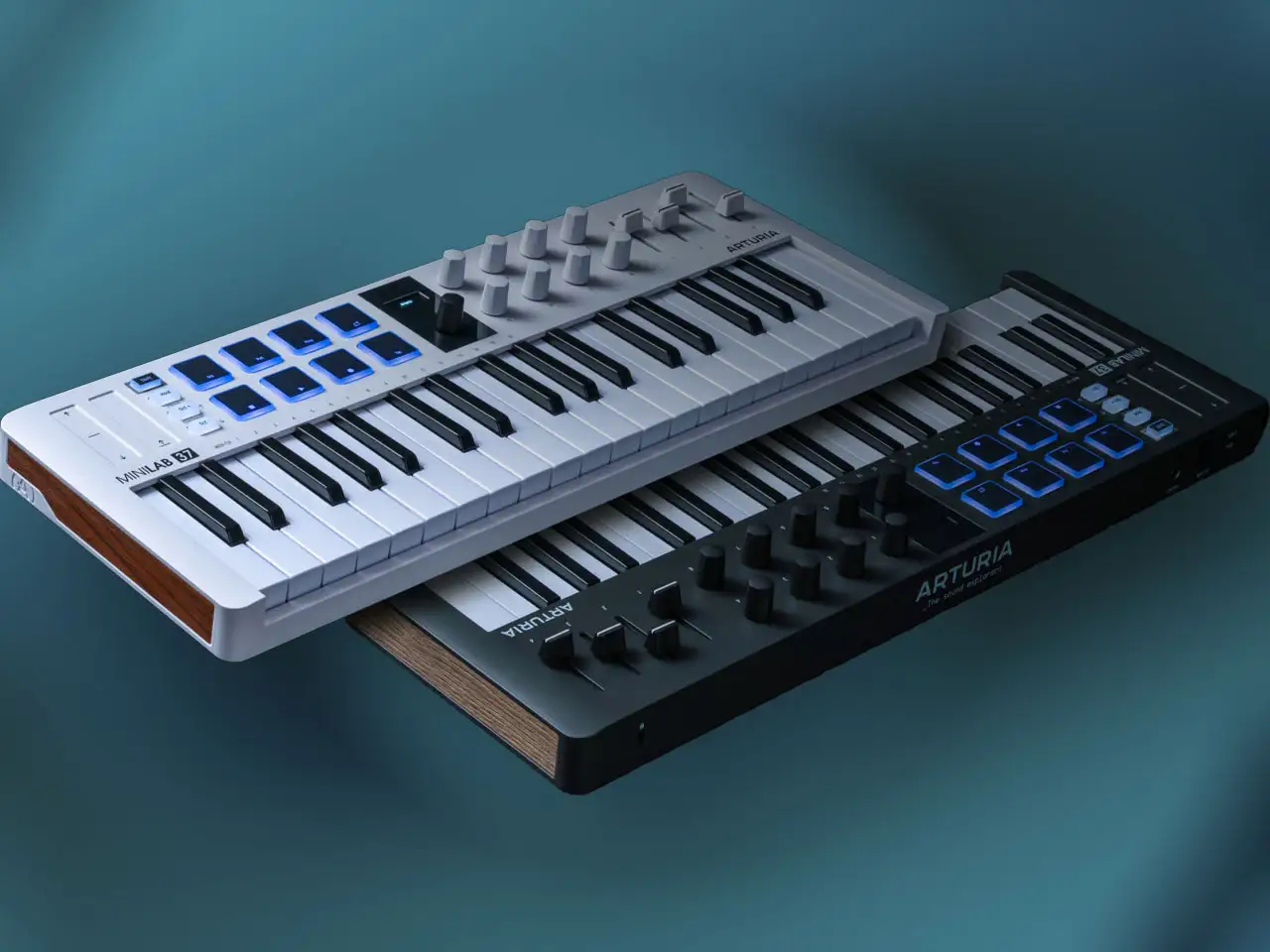
The Arturia MiniLab 3 has been one of the most consistently recommended compact MIDI controllers for iPad production — bus-powered, class-compliant via USB-C, small enough to sit in front of an iPad without dominating a desk, and well-priced at $149. The one criticism that comes up repeatedly is the 25-key limit. A single octave of separation between your lowest and highest reachable note forces constant octave-shifting during even moderately complex performances, and playing anything that requires both hands simultaneously in different registers becomes an exercise in compromise. The MiniLab 37, announced today, is Arturia’s direct answer to that complaint. It adds exactly 12 keys — one full octave — to the MiniLab formula, bringing the total to three octaves for $199. Everything else about the controller stays essentially the same, which is either reassuring or underwhelming depending on what you were hoping for.
The extra octave matters more than the number sounds on paper. With 37 keys you can hold a bass chord in the left hand and play a melody with the right simultaneously, without either hand running out of range. A root-plus-fifth-plus-octave bass voicing and a one-handed melody span comfortably within those 37 notes, and you can play wide piano-style chords without immediately needing to shift position. For producers who primarily sketch melodic ideas and chord progressions — rather than finger-drumming on the pads — that playing freedom is the single most practical improvement in the controller. The people who genuinely need it will recognize the problem immediately. If you rarely hit the octave limit on the MiniLab 3, the MiniLab 37 offers you nothing meaningfully different for the extra $50. If you regularly find yourself hitting the top or bottom of the 25-key range mid-phrase and interrupting your playing to shift, the upgrade is straightforward. The MiniLab 37 also comes in black and white color options, and the dimensions shift accordingly: 503 x 183 x 54mm and 1.17kg compared to the MiniLab 3’s considerably more pocket-friendly footprint. It is still compact by any reasonable standard, but it is no longer small enough to drop in a bag without noticing it.
One notable change is the control surface layout. On the MiniLab 3, the eight RGB pads sit on the left side of the unit and the encoders and faders are on the right. The MiniLab 37 reverses this arrangement: pads are now on the right, encoders and faders on the left, and the mini display is centered between them. Whether this is better depends entirely on how you use the controller. Finger drummers who play the pads with their right hand while the left plays keys will prefer the new layout. Producers who primarily use the encoders for DAW parameter control and reach for the pads occasionally may find the original layout more natural. Neither is objectively correct, but it is worth knowing before you buy if you are coming from the MiniLab 3 — muscle memory for control positions will need relearning. The mini display and clickable browser knob remain, with the same function: navigate presets and settings, get real-time visual feedback on encoder adjustments, and access the Chord mode and arpeggiator configuration menu. The touch-sensitive pitch bend and modulation strips are present on the MiniLab 37 in the same form as the MiniLab 3 — capacitive rather than physical wheels, which remains a point of preference. Some producers strongly prefer a physical wheel for pitch bend in particular; the touch strips require a lighter, more precise finger contact than a physical spring-loaded wheel and feel different in an expressive playing context.
For iPad producers specifically, the connectivity story is identical to the MiniLab 3. The USB-C port is bus-powered and class-compliant, which means it connects directly to any USB-C iPad — iPad Pro, iPad Air, iPad mini 6th gen and later — and is recognized immediately without drivers or configuration. An adapter is required for older Lightning-port iPad models. The 5-pin DIN MIDI output is the addition that matters most for hardware-heavy setups: it lets you run a MIDI cable from the MiniLab 37 directly to an external synthesizer, drum machine, or any hardware that accepts MIDI in, without routing through a computer or audio interface. This makes it a genuinely useful controller hub for a mixed iPad-plus-hardware rig. The control pedal input accepts sustain, expression pedal, or footswitch — useful for hands-free sustain while both hands are occupied playing the extended keybed. Arturia MIDI Control Center handles custom mapping, user preset storage (up to five user presets), and DAW-specific configuration. Deep integration scripts are available for Ableton Live, Logic Pro, Cubase, FL Studio, Bitwig, and Reason, and MCU/HUI protocol support covers any other DAW with a standard implementation. NKS compatibility opens the controller to Native Instruments’ Komplete Kontrol ecosystem directly.
The software bundle is identical to the MiniLab 3: Analog Lab Intro, Ableton Live Lite, Native Instruments Komplete 15 Select (choice of Beats, Band, or Electronic bundle), a two-month Loopcloud subscription with two free sample packs, and a Melodics unlimited trial. These are desktop software titles rather than iOS applications — the bundle adds real value for producers building a Mac or PC setup alongside their iPad workflow, but contributes nothing directly to mobile-only production environments. For a producer who already owns the MiniLab 3 and primarily uses an iPad, the upgrade case for the MiniLab 37 comes down entirely to whether 12 additional keys solves a problem you currently have. The answer to that question is personal rather than universal. For a producer buying their first compact MIDI keyboard for use with an iPad, $199 for the 37-key version versus $149 for the 25-key version is a $50 decision that buys one full octave of additional playing range — a reasonable trade-off for anyone who plays expressively rather than primarily programming patterns.
Key features:
- 37 Velocity-Sensitive Slim Keys: Three-octave keybed for two-handed playing, wider chord voicings, and lead lines without constant octave-shifting — 12 keys more than the MiniLab 3
- New Control Surface Layout: Pads right, encoders and faders left, display centered — reversed from the MiniLab 3 arrangement
- 16 RGB Performance Pads (2 Banks of 8): Velocity and pressure-sensitive with full-color RGB feedback — finger drumming, clip launching, DAW transport
- 8 Rotary Encoders + 4 Faders: Pre-assigned or fully customizable for sound shaping, DAW mixing, and parameter control
- Mini Display and Clickable Browser Knob: Navigate presets, access Chord mode and arpeggiator settings, and get real-time visual feedback on encoder movements
- Capacitive Touch Pitch Bend and Modulation Strips: Touch-sensitive expression controls (no physical wheels)
- Chord Mode and Arpeggiator: Play rich multi-note chords from a single key; convert any chord into a tempo-synced moving pattern
- 5-Pin DIN MIDI Output: Route MIDI directly to external hardware synthesizers and drum machines without a computer or interface in the chain
- USB-C Bus-Powered, Class-Compliant: Plug directly into any USB-C iPad — no drivers, no separate power supply
- Control Pedal Input: Accepts sustain, expression pedal, or footswitch
- NKS Compatible + MCU/HUI: Native Instruments Komplete Kontrol integration and universal DAW control protocol support
- DAW Integration Scripts: Custom mappings for Ableton Live, Logic Pro, Cubase, FL Studio, Bitwig, Reason, Pro Tools, and Digital Performer
- Eco Design: 50% recycled plastic frame, 100% recyclable packaging, 5-year warranty
- Included Software: Analog Lab Intro, Ableton Live Lite, NI Komplete 15 Select, Loopcloud 2-month subscription + 2 sample packs, Melodics subscription
MiniLab 37 vs MiniLab 3 — Quick Comparison
| MiniLab 3 | MiniLab 37 | |
| Keys | 25 slim-key | 37 slim-key |
| Price | $149 / €99 | $199 / €149 |
| Pad Position | Left | Right |
| Encoders / Faders | 8 / 4 | 8 / 4 |
| RGB Pads | 8 (2 banks) | 8 (2 banks) |
| Display | Left side | Centered |
| MIDI DIN Out | Yes | Yes |
| USB-C / Class-Compliant | Yes | Yes |
| Software Bundle | Identical | Identical |
| Size (mm) | 394 × 148 × 42 | 503 × 183 × 54 |
| Weight | ~0.68 kg | 1.17 kg |
Price: $199 / €149


Leave a Reply