
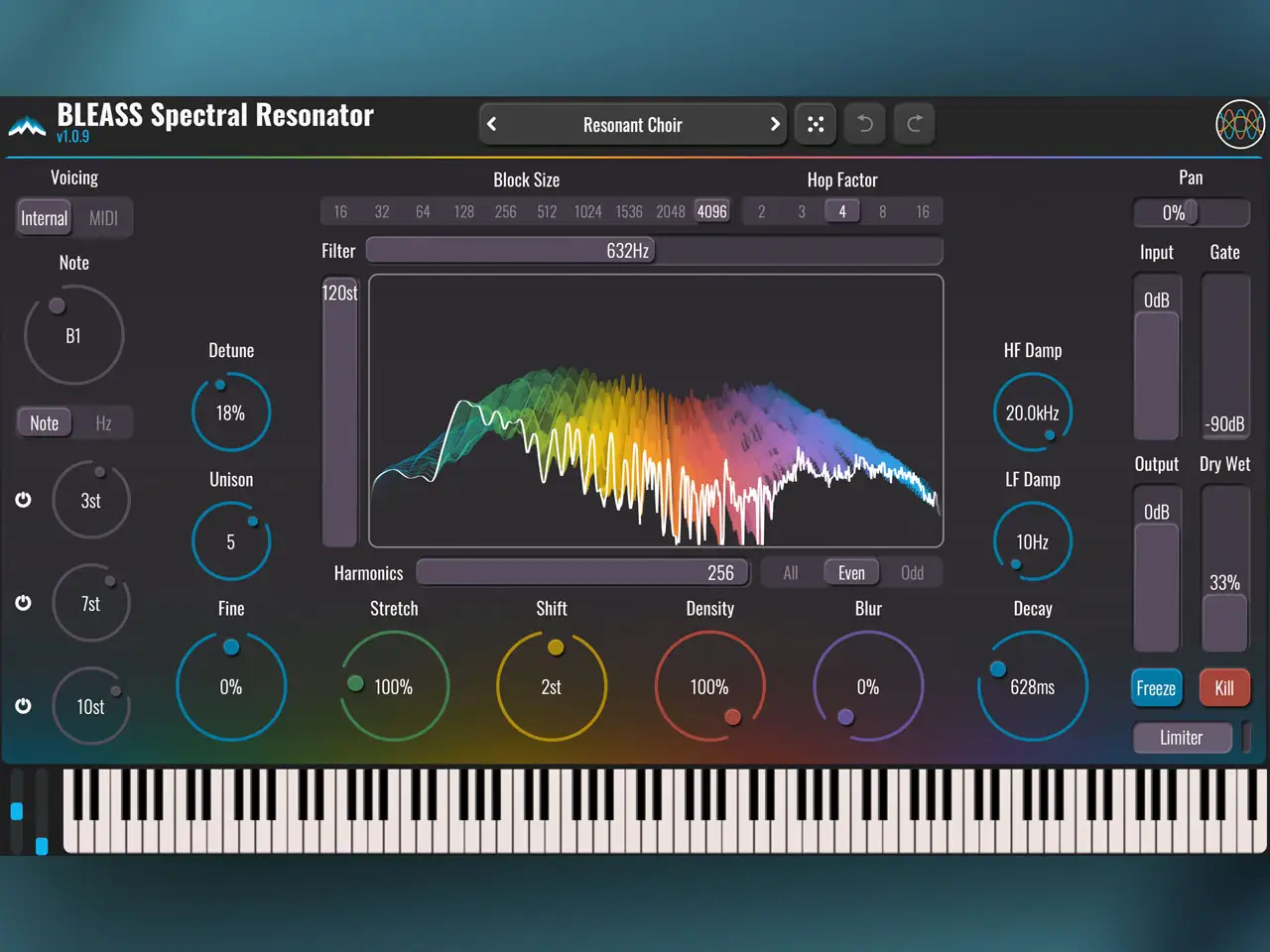
BLEASS has built a consistent reputation on iOS for plugins that are highly visual, CPU-efficient, and produce results that feel liquid rather than clinical. Their new BLEASS Spectral Resonator brings that same approach to spectral processing — an area that has historically been both technically complex and CPU-heavy on mobile. It takes any incoming audio, converts it to the frequency domain, and turns it into a playable, harmonic instrument with up to 256 harmonics per voice and eight-voice polyphony.
The core distinction from a standard resonator is that this one operates in the spectral domain rather than the time domain. By converting the signal to spectral data first, the plugin can shift, blur, filter, and destructure the frequency content of any sound before generating resonances — something that’s difficult to achieve cleanly with analog-style modeling. The results sit somewhere between a vocoder and a tuned reverb: not quite either, but with access to the expressive range of both. Early users on the Loopy Pro forum describe it as one of the more distinct-sounding effects BLEASS has released, with a character that holds up across drums, vocals, and synths without defaulting to the same texture.
The Interactive 3D Spectrogram
As with all BLEASS plugins, the interface centers on a real-time display — here a full 3D spectrogram that visualizes resonator activity over time. It doubles as direct control: you interact with the spectral filter through the same display you use to monitor what’s happening. The visual feedback makes the technical side of spectral processing readable at a glance, which in practice means less time staring at a noise floor and more time shaping sounds.
MIDI-Playable Harmony
Resonances can be generated from an internal four-voice tone generator or directly from incoming MIDI notes. Feed white noise into the plugin, play a chord on a controller, and the noise becomes a lush resonant chord — the MIDI input drives the resonance frequencies directly. With up to eight voices of polyphony, glide, and pitch bend supported, this works as a playable instrument rather than a background texture tool. In AUM you can route any source into it and play it from a MIDI track or controller simultaneously. In Logic Pro for iPad it inserts on any audio track with full MIDI and automation support.
Harmonic Shaping and Spectral Controls
The harmonic architecture is where the plugin earns its depth. The Stretch parameter moves beyond perfect harmonics into inharmonic, metallic, or bell-like territory without losing control. Shift displaces the harmonic series entirely. Density and Damping shape how many harmonics are emphasized and how quickly they decay — Damping is particularly effective for simulating the natural behavior of specific materials. Harmonics can be restricted to even or odd series, which produces dramatically different timbral characters. Spectral blurring and spectral shifting further reshape the resonances after generation. Freeze holds active resonances; Kill clears them. A spectral-domain filter lets you select exactly which frequency range excites the resonators.
Modulation System
The BLEASS modulation system is present in full: two LFOs, an Envelope Follower, and a Sequencer, all mappable to almost any parameter. Map the Envelope Follower to the Decay parameter and louder input signals produce longer ringing resonances. Use the Sequencer on Pitch Shift for glitchy, melodic percussion. The modulation flexibility is what separates this from a static “add shimmer” insert — the resonances can move, follow, and respond.
CPU Performance
Spectral FFT processing is notoriously expensive. BLEASS has optimized it enough that multiple instances run without issue on current iPad hardware — consistent with their other spectral releases. Early reports from users running four instances on older iPad Pro models confirm the DSP meter stays manageable. That matters for AUv3 use in dense sessions where a single CPU-heavy plugin can stall the entire project.
Key features:
- Spectral Domain Processing: Converts audio to the frequency domain for shift, blur, filter, and restructure before resonance generation — not possible with analog-style modeling
- Up to 256 Harmonics Per Voice: Eight voices of polyphony with glide and pitch bend
- MIDI Control: Resonances driven directly from MIDI notes or internal four-voice tone generator
- Interactive 3D Spectrogram: Real-time visualization of resonator activity with direct spectral filter control through the same display
- Harmonic Stretching and Shifting: Move beyond perfect harmonics into inharmonic, metallic, and bell-like textures
- Even / Odd Harmonic Series: Restrict harmonics to even or odd series for distinct timbral characters
- Density and Damping: Control harmonic emphasis and decay character — simulates material behavior (wood, glass, metal)
- Spectral Blur and Spectral Shift: Further reshape resonances after generation
- Spectral-Domain Filter: Selects which frequency range excites the resonators
- Freeze and Kill Controls: Hold active resonances or clear them instantly
- Full BLEASS Modulation System: Two LFOs, Envelope Follower, and Sequencer — all mappable to almost any parameter
- AUv3 on iPhone and iPad; also available as VST3/AU/AAX for Desktop (separate purchase)
App price: $14.99 intro price until June 1st, $19.99 after that.
No in-app purchases.
Also available for Desktop as VST3/AU/AAX — separate purchase.
Original release: May 13, 2026 | Latest update: May 13, 2026


