
Fingerlab has been making visually inventive iOS music apps for over a decade, and their releases tend to share a common trait: the interface is not just a skin on top of standard controls, it is part of the instrument. Jynth follows that logic. It is a polyphonic analog synthesizer modeled on the Roland Juno-106 voice architecture — one of the most imitated synth engines in music software history — but it couples that foundation with a physics-based modulation system that has no direct equivalent on iOS. The Juno-106 is the right choice as a starting point precisely because most musicians already know what it sounds like. The lush chorus pads, the warm resonant filter sweeps, the thick unison bass tones. Fingerlab is not trying to make you forget those sounds. The physics engine is built on top of them, not instead of them. The result is that familiar Juno warmth that can evolve and move in ways no hardware Juno-106 ever could, driven by simulated physical forces rather than the repeating cycles of a conventional LFO.
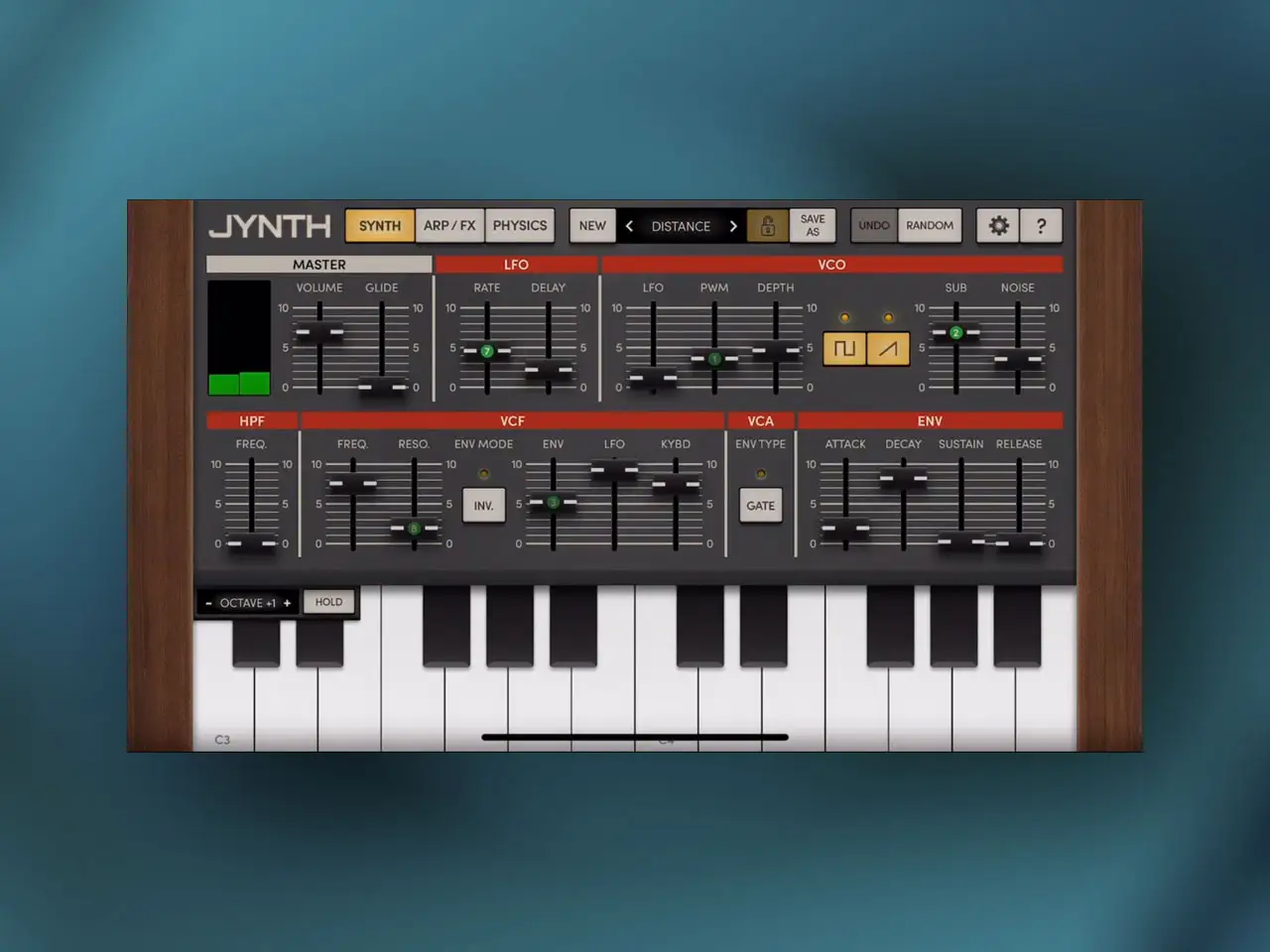
The voice architecture stays true to the Juno-106 blueprint. A single VCO generates pulse-width modulation alongside square, sawtooth, sub-bass, and noise waveforms, which can be mixed in any combination per patch. The signal then passes through a dual-filter configuration: a non-resonant high-pass filter for low-end trimming followed by a resonant voltage-controlled filter with invertible envelope routing, LFO depth control, and key tracking. The invertible envelope on the VCF is one of the Juno-106’s defining characteristics — switching the envelope polarity turns a standard filter open into a filter close, giving you that distinctive plucked and percussive quality on synth patches that the original hardware was famous for on pop records throughout the 1980s and early 1990s. The resonance pushes cleanly into self-oscillation territory, which paired with key tracking produces a pitched sine wave that tracks the MIDI input. None of this is new for a Juno emulation, but the implementation here sounds properly analog in character rather than sterile. The sub-oscillator sits one octave below the main oscillator and adds weight to bass patches that a single VCO alone cannot produce at lower polyphony counts.
The physics modulation engine is the part that requires more explanation than a typical feature list provides, because the concept itself is genuinely different from anything in the standard modulation toolkit. A conventional LFO produces a repeating waveform — sine, square, triangle, saw — at a fixed rate and depth. It is predictable by design: after one cycle, you know exactly what the next cycle will do. Physics modulation does not work that way. Instead, Jynth treats each modulator as a physical object with its own mass, velocity, and environmental constraints. You assign a physics parameter — gravity (constant downward pull), bounce (elastic collision response), impulse (a sudden force applied at a trigger point), friction (resistance that slows movement over time), or angle (directional bias on the force vector) — and that combination drives the modulation target dynamically. The object’s path through the modulation space changes based on how those forces interact, and because physical simulation responds to initial conditions and accumulated state rather than a repeating cycle, the modulation pattern is never exactly the same twice. Up to eight of these physics modulators can run simultaneously, each assigned to a different parameter — VCF cutoff, resonance, pulse width, oscillator mix, VCA level, or any other available destination. The practical result is that pads evolve differently on every pass, arpeggiated patches have subtle timing and tonal variation between repetitions, and long-sustained notes breathe and shift in ways that static LFOs cannot replicate. For ambient work and textural sound design, this is the most interesting modulation concept to appear on iOS in some time.
The effects section covers Tremolo, Flanger, Chorus, Delay, and Reverb. The Chorus in particular is essential on a Juno emulation — the original hardware’s BBD chorus circuit is as responsible for the Juno-106 sound as the oscillator and filter are — and Fingerlab’s implementation produces that familiar wide, slightly detuned stereo spread that makes Juno pads recognizable at a distance. The built-in arpeggiator handles basic up/down/random patterns but is not the deep rhythmic generator that some of Fingerlab’s other apps offer. For more complex sequencing, you are better served by running Jynth inside a host and driving it from an external MIDI sequencer. As an AUv3 plugin inside Drambo, the physics modulators expose their parameters for host automation, which opens up the possibility of driving the physics modulation system from Drambo’s modular signal flow — a genuinely interesting combination. In AUM, Jynth loads cleanly as a standard instrument plugin with stable background audio, and multiple instances run with manageable CPU overhead at moderate polyphony counts. The app is a universal purchase covering iPhone, iPad, and Apple Silicon Macs under a single payment.
The free version gives you enough to evaluate whether the physics engine concept works for your workflow — basic presets, the core voice architecture, and limited access to the modulation system. The $6.99 full unlock is where the instrument opens up completely. Preset creation and saving, access to all factory presets, the complete multi-FX rack, the advanced physics modulators (the full gravity, bounce, impulse, friction, and angle parameter set), the patch randomizer, and the undo system all require the unlock. This is the right structure for a complex instrument: try the concept for free, pay once if it fits your workflow. The physics modulation system is the genuine differentiator here, and evaluating Jynth without unlocking it gives you only a partial picture of what the instrument can do. At $6.99 for a permanent full unlock with no subscription, the full version is well-priced for what it delivers. For producers working in ambient, neo-soul, synthwave, or any genre that relies on evolving analog textures, Jynth offers a modulation approach that is meaningfully different from what is already on the market.
Key features:
- Juno-106 Inspired Voice Architecture: Single VCO with PWM alongside square, sawtooth, sub-bass, and noise waveforms, mixed per patch and routed through a dual-filter configuration
- Dual Filter Configuration: Non-resonant HPF for low-end trimming followed by a resonant VCF with invertible envelope routing, LFO depth, key tracking, and self-oscillation
- Physics Modulation Engine: Up to 8 simultaneous physics-driven modulators using gravity, bounce, impulse, friction, and angle — produces non-repeating, organically evolving modulation patterns
- 5-Module Effects Rack: Tremolo, Flanger, Chorus, Delay, and Reverb — the Chorus is modeled on the Juno-106 BBD circuit character
- Built-In Arpeggiator: Up/down/random pattern modes for basic melodic triggering
- Patch Randomizer: One-tap patch generation for fast exploration (full unlock required)
- Full MIDI In Support: External keyboard, controller, and sequencer compatibility
- Universal AUv3 and standalone on iPhone, iPad, and Apple Silicon Mac — single purchase covers all platforms
App price: Free.
In-app purchases: Full Version Unlock — $6.99 (unlocks preset creation and saving, all factory presets, complete multi-FX rack, advanced physics modulators, patch randomizer, and undo system).
Original release: June 4, 2026 | Latest update: June 4, 2026


