
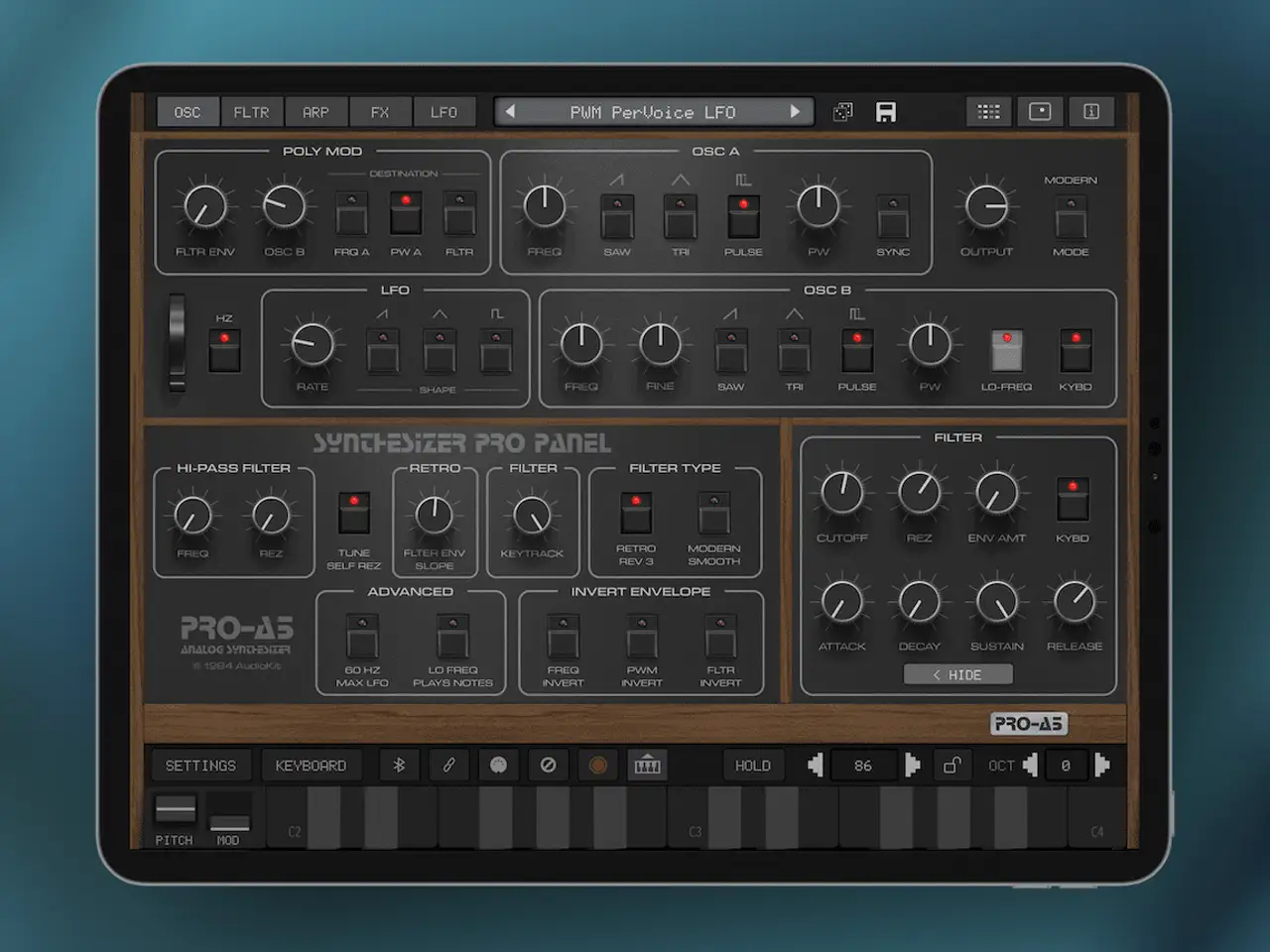
If you owned a Prophet-5 in 1979, you paid around $4,000 for it. Matthew Fecher is asking $4.99 for a pre-order on something that aims to model its core architecture on an iPhone. That is the context for the PRO-A5 Synth, the latest instrument from AudioKit Pro and the team behind the Super J8 — which remains one of the most convincing analog emulations available on iOS. The PRO-A5 is not yet released; it lands June 4th. But the pre-order is live now at $4.99, rising to $29.99 at launch. That gap is large enough that it is worth paying attention to, even before hearing a note from the finished build. What AudioKit Pro has shown in the walkthrough video gives a clear picture of what to expect, and based on their track record, there is reason to take this seriously.
The architecture is built around two oscillators — A and B — with hard sync and full PWM support. But the filter section is where the PRO-A5 makes its most interesting argument. There are two distinct filter circuits available. The Classic REV 3 filter reproduces the stepped, gritty behavior of vintage hardware, including the stair-step parameter movement that defined the original’s filter sweeps and the aggressive resonance that could push into self-oscillation. The Modern Smooth filter is a cleaner contemporary alternative for producers who want the oscillator character without the hardware idiosyncrasies. Switching between them mid-patch changes the feel of the instrument completely. The Tune Rez button — which auto-tunes the filter’s self-oscillation into a playable pitched sine — is the kind of feature that sounds like a gimmick until you actually use it. Running it as a clean oscillator under a chord voicing adds a sub presence that is genuinely hard to achieve any other way. AudioKit Pro also stress-tested the PWM envelope behavior across 30 edge cases to match real component behavior, which means the clicks and warm transient offsets that analog hardware produces are preserved rather than smoothed away. For ambient work and lo-fi production this matters. It is the difference between something that sounds modeled and something that sounds real.
The polyphony sits at 10 voices, which effectively doubles the five-voice count of the hardware inspiration. You can run those as 10 independent voices for full chord work, or stack them as 5-voice poly-unison for fat, detuned pads. The Poly-Mod routing — routing the Filter Envelope and Oscillator B as per-voice modulation sources targeting Oscillator A’s pitch, pulse width, or filter cutoff — works the way it did on the original hardware, which gives you that specific animated, evolving pad sound without needing external modulation. The modulation matrix runs three LFOs with analog resistor-mix curve shapes and soft-limiting, routed across more than 60 destinations. LFOs cross-modulating other LFOs is included, which opens up complex motion that most mobile synths with comparable price points cannot touch. As an AUv3 inside Logic Pro for iPad, the PRO-A5 will load as a standard instrument plugin with full automation support. In AUM, you can stack multiple instances — one for a bass voice, one for a pad layer — and the 2x oversampling keeps the low end clean even at high polyphony counts.
The FX suite is more complete than most synth apps bother to include. A Cascading Reverb, Analog Tape Delay, vintage Chorus, Bit Crusher, and the Rage Limiter — AudioKit’s high-gain saturation stage — cover most production needs without reaching for an external effects chain. The 500-plus presets from designers including Moby Pixel, Doug Woods, Bri Kup, DMT Cymatics, Red Sky Lullaby, and Joe Zeno give you an immediate library to work from rather than starting from scratch. The step sequencer and arpeggiator are on board for pattern work, and two assignable XY Touch Pads handle real-time FX manipulation in live settings. One honest note: MPE and polyphonic aftertouch are confirmed but not shipping at launch. They will arrive as a free update. If those features are critical to your workflow, factor that into the decision. For everyone else, the pre-order price versus the retail price makes this straightforward. The PRO-A5 is a universal purchase covering iPhone, iPad, and Apple Silicon Macs — one payment, all platforms.
Key features:
- 10-Voice Polyphony: Run as 10 independent voices or as 5-voice per-note poly-unison stacks for dense, detuned pads
- Dual Filter Architecture: Classic REV 3 filter with authentic stepped parameter behavior and aggressive resonance, plus a Modern Smooth filter for clean sweeps
- Tune Rez: Auto-tunes the filter self-oscillation circuit into a playable pitched sine wave oscillator
- Authentic PWM Behavior: Pulse Width Modulation envelope stress-tested across 30 edge cases to preserve hardware clicks, pops, and warm transient offsets
- True Poly-Mod Routing: Filter Envelope and Oscillator B act as per-voice modulation sources targeting Oscillator A’s pitch, pulse width, or filter cutoff
- 3 LFOs with 60+ Destinations: Analog resistor-mix curve shapes with soft-limiting; LFOs can cross-modulate each other
- 2x Oversampling: Aliasing-free low end and clean high frequencies at all polyphony levels
- Premium FX Suite: Cascading Reverb, Analog Tape Delay, vintage Chorus, Bit Crusher, and Rage Limiter high-gain saturation
- 500+ Presets: Designed by Moby Pixel, Analog Matthew, Doug Woods, Bri Kup, DMT Cymatics, Red Sky Lullaby, and Joe Zeno
- Performance Tools: Vintage-style step sequencer, arpeggiator, and dual assignable XY Touch Pads
- MPE and Polyphonic Aftertouch: Confirmed as a free update post-launch
- Universal AUv3 and standalone on iPhone, iPad, and Apple Silicon Mac — single purchase covers all platforms
App price: $4.99 (pre-order; regular price $29.99 from June 4th).
No in-app purchases. No subscription.
Expected release: June 4, 2026


