
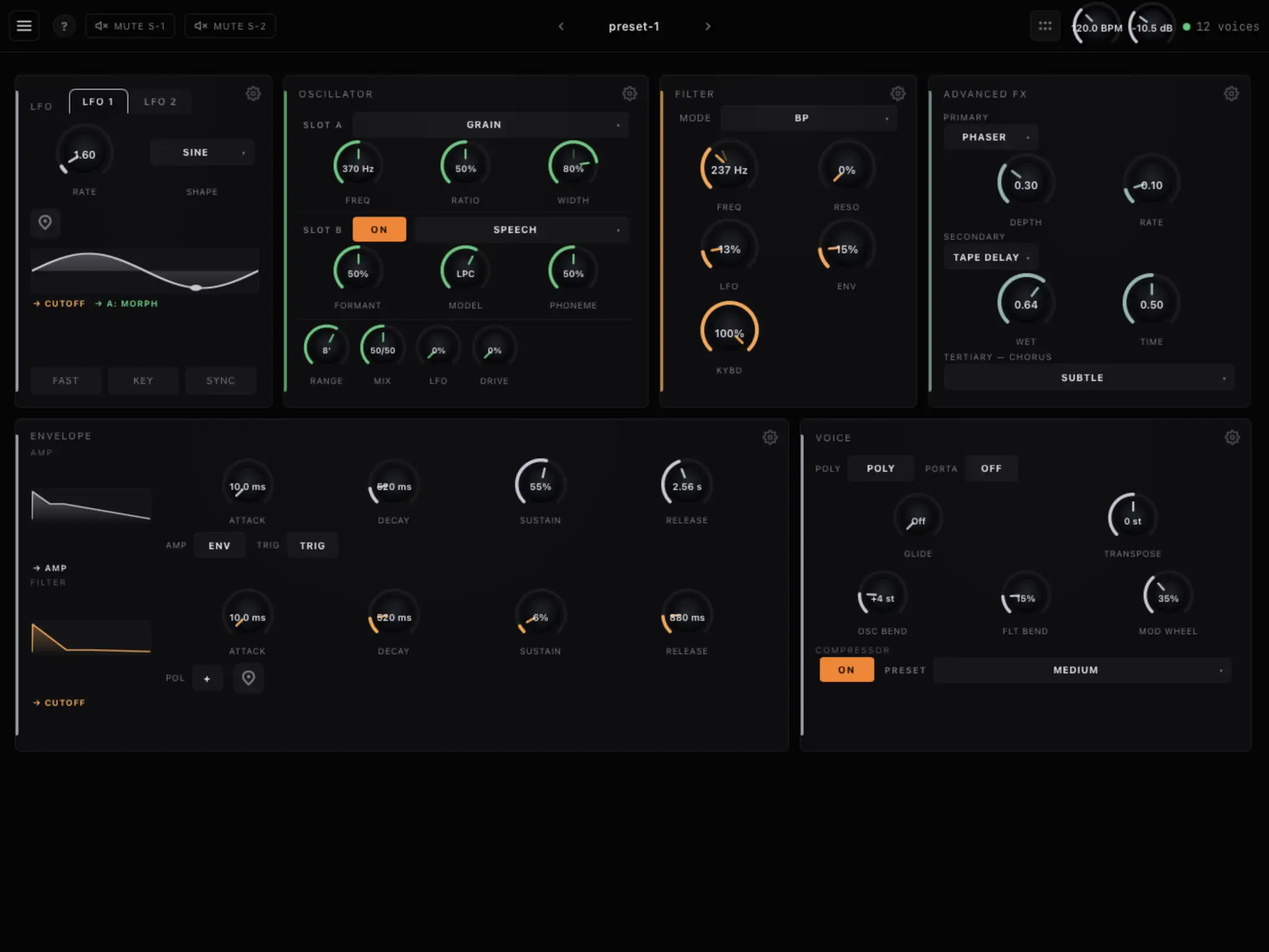
Developer Mathias Kirkerød has released S-2, a completely free polyphonic synthesizer for iPhone, iPad, and Mac. The app launches as a Standalone, an AUv3 plugin for iOS hosts like AUM, GarageBand, and Cubasis, and an Audio Unit (AU) for Logic Pro for iPad and Mac. No in-app purchases, no subscription tier, no limited-feature free version — the full instrument is available at no cost from day one. It is built around algorithms inspired by open-source Mutable Instruments models, and its MIDI mapping layout is specifically designed to complement the Roland AIRA Compact S-1 hardware synthesizer, though it functions as a fully independent instrument with or without that hardware.
What Mutable Instruments Algorithms Mean in Practice
Mutable Instruments released the source code for their Eurorack modules as open-source before the company closed in 2023. That codebase has since been implemented across a wide range of software and hardware projects — the algorithms are well-documented, widely tested, and have a specific sonic character that users of Plaits, Braids, and other MI modules will recognize. Kirkerød has built S-2’s engine on those algorithms, which means the synthesis voices have the same timbral foundation as those modules without requiring a Eurorack case. For iOS producers who came to MI algorithms through software like Cardinal or Audulus, S-2 brings those sounds into a standard AUv3 plugin context with a straightforward synth interface rather than a modular patching environment.
The practical benefit is a synthesis palette that covers ground most standard virtual analog synths don’t. Classic analog shapes (saw, square, sub, noise, PWM) are the starting point, but the MI-derived engines add wavetable morphing textures, FM voices, speech and formant synthesis, chord structures, and physical modeling of plucked strings — six distinct synthesis approaches available within the same instrument, selectable per voice slot.
Dual Engine Architecture: Two Synthesis Styles Per Voice
Each voice in S-2 runs two parallel engine slots that mix together before going through the filter. This means every patch can combine any two of the available synthesis approaches — a classic analog saw layer underneath a wavetable texture on top, or an FM carrier mixed with a plucked string to add metallic transients to a physical model, or speech synthesis running alongside classic analog for a vocal-harmonic hybrid. The two slots run independently within each voice, so the layering happens at the voice level rather than as two separate instrument tracks in the host.
The range of combinations this creates is substantial. FM engines produce the sharp attack transients and metallic mid-range that analog oscillators lack. Speech synthesis in the MI model can generate vowel-like formant movement that adds expressiveness to pads without requiring a vocoder. Chord structures from the MI Plaits algorithm generate multi-note clusters from a single voice, effectively expanding apparent polyphony. The dual slot system means you can access all of this in one preset rather than routing multiple synth plugins through a host mixer to achieve the same layering.
Classic Mode vs. Modern Mode: Two Complete Signal Paths
S-2 ships with two entirely separate processing environments rather than one configurable signal chain. Choosing between them changes the filter type, the effects architecture, and the overall tonal character of the instrument.
Classic Mode routes the combined engine output through a ladder filter — the warm, resonant filter architecture associated with vintage analog hardware. From there the signal passes through a fixed serial effects chain: Delay into Chorus into Reverb. The chain is intentionally straightforward. You set the filter character and the three effects in sequence, and the result has an organic, analog warmth that suits pads, basses, and traditional synth textures. The ladder filter’s self-resonance behavior at high Q settings adds a singing quality that the state variable filter of Modern Mode doesn’t produce.
Modern Mode replaces the ladder with a State Variable Filter offering Low-Pass, Band-Pass, and High-Pass configurations. SVF is precise, transparent, and well-suited to sharper-edged synthesis work — FM voices, digital wavetable textures, and anything where the filter needs to track pitch cleanly rather than add coloration. The effects section opens up into a three-slot modular rack where you choose from eight available processors: Bitcrusher, Drive, Flanger, Phaser, Auto-Filter, Tape Delay, Plate Reverb, and Chorus. Load three that work for your patch rather than working through a fixed chain. This architecture suits experimental and hybrid patches that need customized processing rather than a standard reverb tail.
Modulation: Single-Screen Matrix Without Sub-Menus
S-2 includes two LFOs and a dedicated filter envelope. Both LFOs offer six waveform shapes — sine, triangle, saw, square, random, and noise — with optional host-clock sync, making them useful for both slow pad movement and rhythmically locked modulation. The filter envelope has two destination slots for routing its shape to parameters beyond the filter cutoff. All modulation routing is managed in a single, central matrix dialog window rather than spread across separate sub-menus per modulation source. You see everything at once. MIDI Learn mode lets you click or tap any onscreen parameter knob to map it to an external controller immediately, without navigating into a settings menu to assign it.
For producers who use S-2 alongside the Roland AIRA Compact S-1 hardware, the MIDI mapping layout is designed to align with the S-1’s control surface natively. The S-1 is a compact hardware synth with a small form factor and MIDI output — using S-2 as a software voice expander that responds to the S-1’s controls without manual mapping setup is the specific workflow Kirkerød built toward. S-2 is an independent third-party application and carries no affiliation with Roland Corporation.
Who This Is For and Where It Sits
Free polyphonic synthesizers on iOS are rare enough that S-2 is immediately worth trying on that basis alone. But the specific architecture makes it most useful for a particular type of producer: someone who wants synthesis depth beyond standard virtual analog — particularly the MI-derived models — without building a modular environment in Cardinal or AUM with custom signal flow. S-2 presents those algorithms in a traditional synth interface with a filter, modulation matrix, and effects chain, which makes them approachable for producers who think in synth terms rather than modular terms. The dual engine slots make it genuinely more flexible than most free instruments at any price point. The two complete signal path modes (Classic and Modern) mean it covers warm analog territory and precise digital territory without requiring a separate instrument for each.
Key features:
- Dual Engine Slots Per Voice: Layer any two synthesis approaches per voice — all mix before the filter. Six engine types: Classic Analog (saw/square/sub/noise/PWM), Wavetable, FM, Speech/Formant, Chord Structures, Plucked String
- Mutable Instruments-Inspired Algorithms: Engines built on open-source MI model code — the same timbral foundation as Plaits and Braids, in a standard synth interface
- Classic Mode: Ladder filter with fixed Delay → Chorus → Reverb serial effects chain — warm analog character for pads, basses, and traditional textures
- Modern Mode: State Variable Filter (LP/BP/HP) with a 3-slot modular effects rack — load any three from Bitcrusher, Drive, Flanger, Phaser, Auto-Filter, Tape Delay, Plate Reverb, Chorus
- Two LFOs: Six waveforms each (sine/triangle/saw/square/random/noise) with optional host-clock sync
- Filter Envelope: Two destination slots for routing beyond cutoff
- Single-Screen Mod Matrix: All modulation routing in one central dialog — no sub-menus. MIDI Learn via tap on any onscreen parameter knob
- Roland AIRA Compact S-1 MIDI Mapping: MIDI layout designed to align with the S-1 hardware control surface natively — no manual mapping required. S-2 is a third-party independent app, not affiliated with Roland
- Standalone, AUv3, and AU — iPhone, iPad (iOS 16.0+), and Mac
App price: Free.
No in-app purchases.
Original release: May 18, 2026 | Latest update: May 18, 2026


