
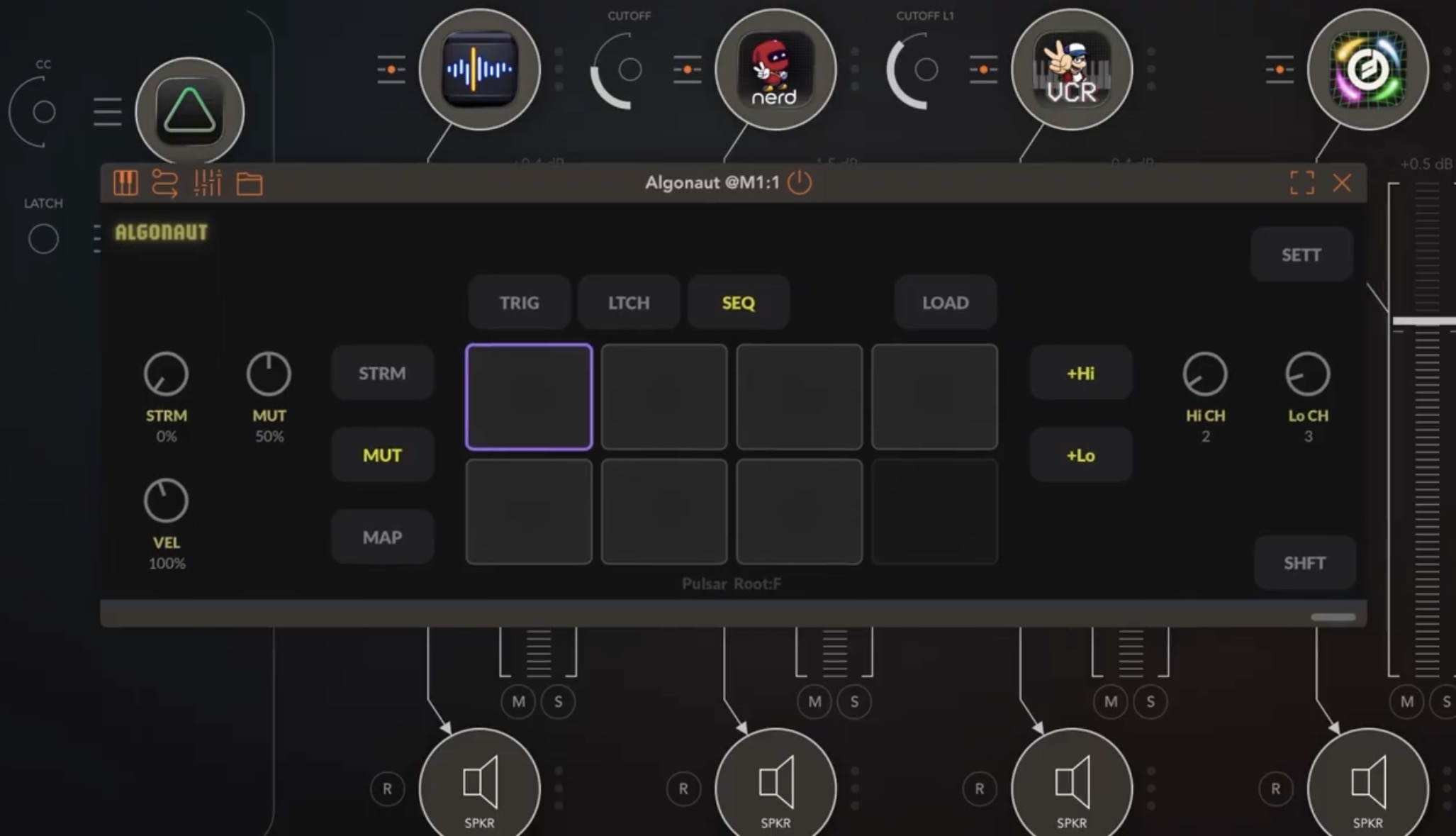
Axart Labs OÜ — the Estonian developer behind the MIDI modulation tools mLFO and ChaosArp 2 — released Algonautic, an AUv3 MIDI chord pad instrument for iPad built around one specific concept: the harmonic language of Estonian ambient artist Achillefs Sourlas, who records under the name Algonaut. The chord voicings in the app come directly from Sourlas’s studio catalog — Sonic Dreams Vol. 1 and 2 — transcribed and organized into a set of eight interactive pads. Tap a pad, and a fully voiced chord fires on the MIDI output. Nothing more sophisticated than that at the entry level, but several layers of performance behavior sit on top of that basic operation that make this more than a static chord library. The app was originally released as “Algonaut” in late May 2026 and renamed “Algonautic” in v1.1.3, presumably to disambiguate from the artist it references.
The performance system is where the app’s actual depth lives. Gate and Latch modes handle how long a chord stays active after you tap — Gate holds the chord for exactly as long as you keep touching the pad, Latch keeps it ringing until you tap again or trigger a different pad. Strum mode spreads the individual notes of a chord across a short time window rather than firing them simultaneously, adding a natural guitar-like attack to what would otherwise be an instant block chord. Transition rules step through chords in a fixed sequence or pick the next one at random, which creates self-advancing progressions without manual input — useful for generative ambient work where you want movement without micromanaging every change. Mutation mode takes this further by autonomously introducing inversions and harmonic variations to the playing pads over time, shifting the harmony gradually while the fundamental chord set stays the same. DAW sync is available for tempo-locked triggering, or you can drive everything manually from the touch interface.
The Two Part Doublers are the most practically useful routing feature. Each doubler adds a bass or top-voice doubling to whatever chord is active, and each one outputs on its own dedicated MIDI channel — independent of the main chord output channel. In AUM this means you can route the bass doubler to a dedicated bass synth on one channel, the melody doubler to a pad or lead on another, and the main chord output to a third instrument, all from a single Algonautic instance. In Logic Pro for iPad, you’d use External MIDI routing or the Software Instrument track’s MIDI output to separate the channels. It’s the kind of routing architecture that only makes sense if you’re already thinking about multi-instrument setups, but for producers who work with layered synth textures it adds real value without requiring any manual splitting.
The limitation that split the Loopy Pro community on this app is the chord library itself — it is entirely fixed. You cannot edit the voicings, substitute your own chords, or add new ones. Every pad maps to a specific chord from Sourlas’s catalog, and the only variation available is transposing the entire set to a different key in one tap. Community reaction ranged from “the chords sound beautiful” (they genuinely do, as the video below shows) to “a promo for an unknown project with a $5 price tag.” The closest analogy the forum arrived at was Brian Eno’s album companion apps — a performance tool built around a specific artist’s harmonic sensibility rather than a general-purpose chord tool where you bring your own material. That framing is accurate. If Algonautic’s chord vocabulary overlaps with the textures you already want to make, the performance engine and routing features are genuinely well considered. If your workflow starts from your own harmonic choices, the fixed library is a hard wall. Also worth flagging explicitly: Algonautic produces no audio on its own — it is MIDI only, with zero audio latency added to your chain. An early App Store reviewer gave it one star after loading it in AUM and hearing nothing; a subsequent reviewer correctly pointed out it works exactly as designed. If you’re not routing its MIDI output to an instrument, silence is the expected result.
At $4.99 with no in-app purchases and a surprisingly low iPadOS 12.0 minimum, Algonautic is accessible on older iPads. It’s iPad-only — no iPhone version, which is a design choice the community found puzzling given the interface’s compact footprint in the AUM plugin panel. Axart Labs has shown a clear pattern of small, focused MIDI tools with ChaosArp 2 and mLFO, so custom chord support arriving in a future update feels like a reasonable expectation rather than wishful thinking — but right now the app ships with what it ships with, and the chord set is closed.
Key features:
- Curated Chord Pad Library: 14 ambient chord voicings from Achillefs Sourlas’s Sonic Dreams catalog, arranged across 8 performance pads — fixed, not editable
- One-Tap Transpose: Shift the entire chord set to any key from a single control
- Gate and Latch Modes: Gate holds the chord while the pad is touched; Latch keeps it active until you change or re-tap
- Strum Mode: Spreads chord note attacks over a short window for natural, guitar-style movement
- Transition Rules: Step through chord pads in order or randomly for self-advancing progressions
- Mutation Mode: Introduces inversions and harmonic variations autonomously over time
- Two Part Doublers: Bass and top-voice doublings added in real time, each on its own independent MIDI output channel for flexible multi-instrument routing
- DAW Sync: Run locked to host tempo or trigger freely by hand
- AUv3 MIDI Effect: Loads in Logic Pro for iPad, AUM, Cubasis, and other compatible hosts — or runs standalone
- MIDI only — no audio engine, no added audio latency. iPad only (no iPhone). iPadOS 12.0 minimum. Not verified for macOS.
App price: $4.99. No in-app purchases.
Original release: May 30, 2026 | Latest update: June 11, 2026 (v1.1.3, renamed from Algonaut to Algonautic)


Leave a Reply