
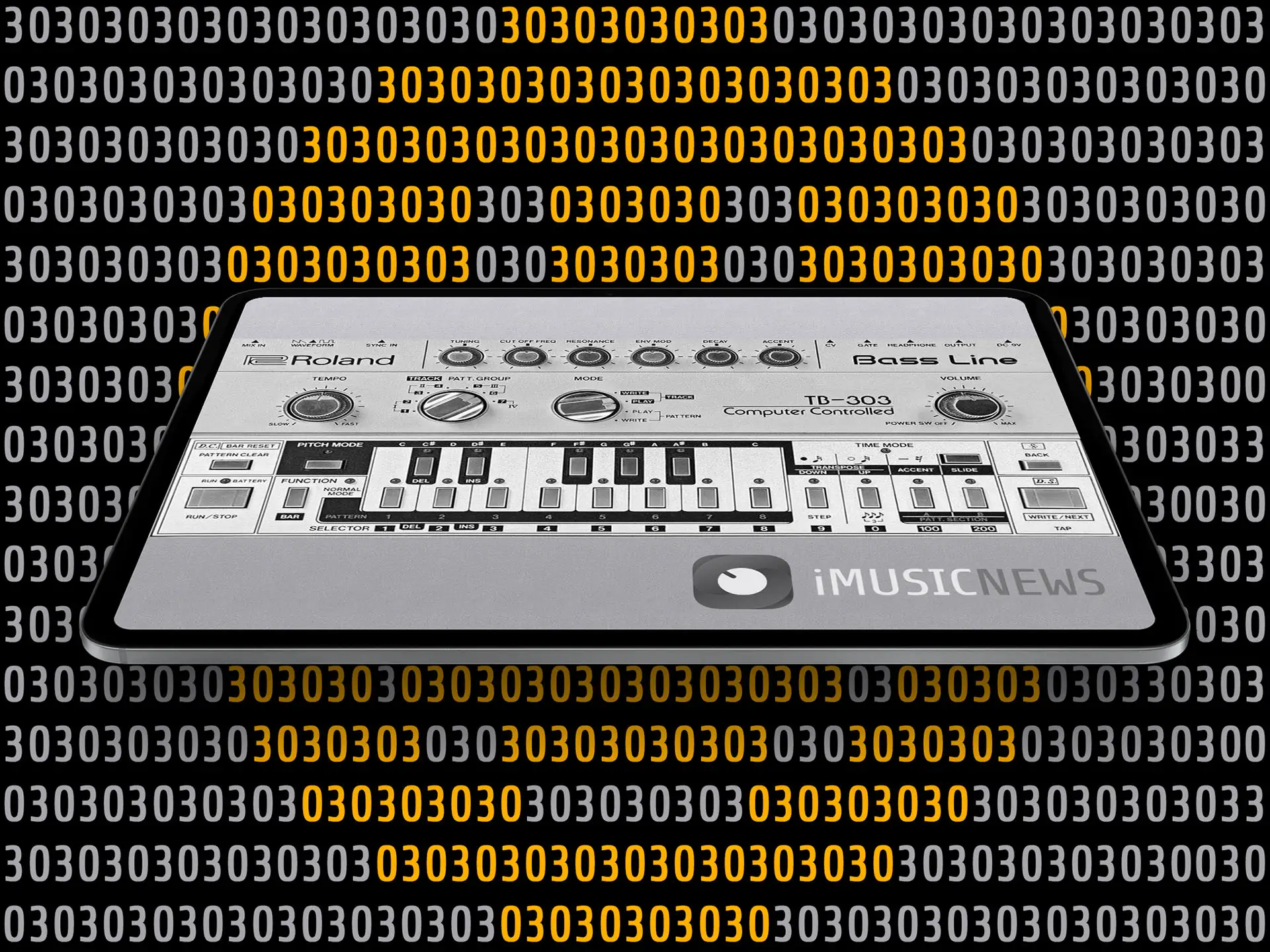
Released by Roland in 1981, the TB-303 (Transistor Bass) was designed by Tadao Kikumoto as a compact, computerized bass guitar simulator aimed at solo musicians. It proved a commercial flop and was discontinued by 1984, only to be rediscovered in Chicago by Phuture on their seminal “Acid Tracks” release. Rather than its intended bass tones, the machine’s squelchy, resonant filter and quirky sequencer with slide and accent functions defined the acid house sound. This unmistakable sound has since shaped electronic music, from Plastikman and Josh Wink to Hardfloor, Daft Punk, Fatboy Slim and generations of producers pushing its limits in clubs and studios worldwide.
Today, the classic 303 acid sound lives on in countless hardware and software emulations, including powerful iPad apps that capture its diode ladder filter, signature sequencer and raw character — perfect for mobile music production, without extra hardware. With the 303’s simple controls and sequencer fitting perfectly on iPad’s touchscreen, producers can tweak resonance, slide, accent and patterns intuitively with touch gestures, making it an ideal platform for recreating those iconic squelchy basslines on the go.
Below, we’ve curated a list of our top 303 emulation apps available on the iPad right now. Whether you’re building full tracks in a DAW or jamming standalone, these AUv3 plugins and apps offer authentic results and will help you get into the 303 day mood. Many of them work seamlessly as AUv3 plugins inside hosts like Logic Pro for iPad or GarageBand, providing endless creative routing options for iPad music production.
Pure Acid by Dmitrij Pavlov (best sound)

Pure Acid stands out as one of the closest emulations available. This comprehensive standalone and AUv3 app pairs a faithful TB-303-style bassline synth with a built-in drum machine and powerful 32-step sequencer, delivering warm, detailed acid lines that users describe as “near-perfect” for live jams and studio work. Its interface rewards practice with deep editing tools, though beginners may find the wealth of options initially overwhelming. Producers love how it integrates with other apps via Ableton Link and export, making it a go-to for authentic acid house grooves on iPad.
Key features include:
- Classic TB-303 controls (Cutoff, Resonance, Env Mod, Decay, Accent) plus distortion and LFO
- 32-step sequencer with pattern chaining, swing, gate, randomize and MIDI export
- 16-part drum machine with 35 classic sounds and full mixing
- AUv3 support with multi-bus output, Ableton Link, IAA and Core MIDI
- 84 factory presets plus unlimited user banks and audio/WAV export
SquareAcid by James Navarro (best feel)

SquareAcid follows closely and, though not the purest 303 sound (pun intended), actually wins on authentic feel. The way its knobs respond when tweaking filter and resonance feels noticeably more “rubbery” and hardware-like than most iOS emulations. It captures the specific way a real 303’s filter interacts with accents and slides, letting you create entirely new rhythms just by turning a knob instead of rewriting the sequence. It’s praised for the grungy, barky character though some note legato note overlap can feel limiting compared to more programmable sequencers.
Key features include:
- Fierce resonant diode-ladder filter with saw/square oscillators and built-in distortion
- Responsive analog-style controls for real-time accent/slide interaction
- Built-in sequencer with MIDI output, Ableton Link, Audiobus and IAA
- AUv3 + standalone support on iPhone and iPad
Troublemaker by Bram Bos (best sequencer)

Troublemaker (including its popular Modded edition) and its companion sequencer Rozeta Bassline — part of the Rozeta Sequencer Suite — offers a unique take with its own sonic personality while nailing the squelch. The standalone app includes a full sequencer with mutation engine for instant acid chaos, while the Rozeta Bassline AUv3 lets you drive any other synth — turning even basic oscillators into convincing 303 lines. It’s known for its easy pattern editing, though some note occasional host compatibility quirks in certain DAWs. It excels for on-the-go acid sessions and MIDI sequencing in iPad setups.
Key features include:
- Authentic diode filter with raspy saw and pulse-width square oscillators
- 1–64 step sequencer with realtime mutation probability and MIDI export
- Full MIDI CC control, Bluetooth MIDI, Ableton Link and Audiobus support
- WAV/MIDI export from standalone mode
Mi-03 Bassline by Darren Mothersel (best budget option)

A standout budget option is Mi-03 Bassline — the best affordable choice at just $2.99. Though not sounding exactly like the original, it comes with a nice enhanced sequencer that works as a separate AUv3 MIDI plugin and can drive any other synth or app. It’s worth checking out for this MIDI sequencing feature alone, plus its modern 303-inspired sound and distortion routing. Users call it “great for generating cool bass lines” and “awesome unit,” though some report occasional MIDI FX quirks in specific hosts.
TV3 – Acid Synth by Imaginando

TV3 brings an eccentric, psychedelic twist with its smiley-face randomizer and generative pattern engine. This AUv3 plugin (also runnable standalone) features dual oscillators, a resonant 24dB filter and multiple distortion modes, plus a clever random sequencer where you dial in complexity, length, scale and key. You can’t manually program every note, but MIDI export and external clocking make it versatile. Producers praise its “super fun” instant acid lines and hypnotic visuals, calling it faster than hardware clones for quick inspiration in hosts like AUM or Loopy Pro.
Key features include:
- Dual oscs (saw/square) with sub oscillator, resonant low-pass filter and accent/decay envelope
- Generative pattern generator with adjustable complexity/scale/key and MIDI export
- Four distortion modes (saturation, wavefolding, fuzz, nock)
- Quick “Acid Boy” randomization and MIDI input for external control
DeeACID by DOTEC-AUDIO

DeeACID delivers a fun, accessible entry point with old-school game-style graphics, hypnotic visualizations and turntable-style controls (DJ deck mode) to seamlessly integrate it into your DJ setup. As a dedicated AUv3 acid bass synth (now with standalone mode), it focuses on effortless phrase generation synced to your rhythm track, plus easy MIDI learn for controllers. The sound isn’t the most clinical replica but nails the playful overdriven character. Recent updates improved analog feel and background performance, making it ideal for quick acid bass in mobile music studio setups.
Key features include:
- Auto-adjusted overdrive and phrase generator with MIDI file export
- Visual effects, easy MIDI controller learn mode and DJ deck tempo fader/bends
- Standalone DJ Deck mode plus Ableton Link support
Other options
For users already invested in bigger ecosystems, Transistor Bass inside FL Studio Mobile provides a clean, no-frills 303-style module with built-in distortion — great if you’re producing full tracks in one app. Korg Gadget’s Chicago gadget offers a taste of the sound within its gadget-based DAW workflow. Pioneering the software 303 emulation scene was ReBirth by Propellerhead (now Reason Studios), which brought authentic acid sounds to iOS for years before being sadly discontinued in 2017.
And for completely free experimentation, the browser-based Roland50.studio runs perfectly in Safari on iPad, letting you jam with a virtual TB-303 alongside TR-808 and SH-101 emulations — no download required.
With all these options, you’re sure to find your perfect squelchy rubbery groove, this 303 days.


Leave a Reply