
The v1.3 firmware and software update (delivered via the IK Product Manager) expands compatibility with popular models including Apple AirPods Max, Audeze S20, and HEDDphone D1. It also brings faster navigation with arrows and smart search in the headphone browser, always-visible model names, double-click selection, preset copy/paste/restore functions, an improved ambience algorithm for more natural spatial depth, an enhanced frequency-response graph with toggleable curves, and quicker User Trim controls. Note that there is still no dedicated iOS app for initial setup and profile loading — everything continues to be handled through the desktop IK Product Manager on Mac or Windows.
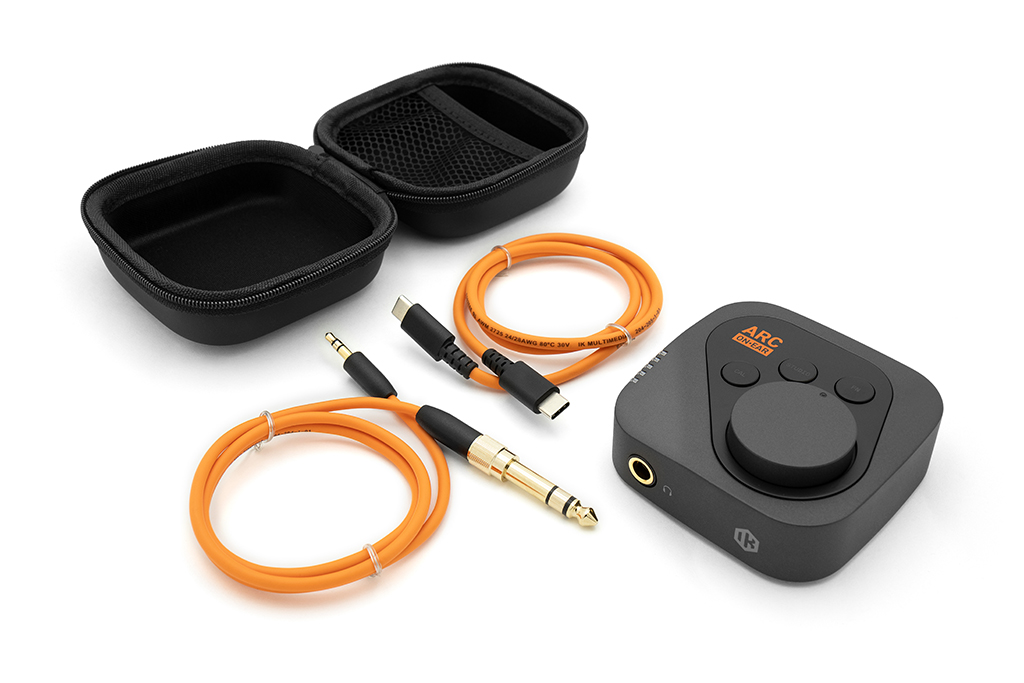
The IK Multimedia ARC ON•EAR is a compact hardware device that transforms any headphones into a professional reference tool through precision calibration, correcting frequency response and stereo imaging for natural, accurate sound. Released in October 2025, it features audiophile-grade components including a 32-bit ESS SABRE converter and a high-power, low-distortion amplifier, ensuring high-fidelity playback. Battery-powered with up to 4 hours of use on its rechargeable battery, it’s ideal for mobile workflows, connecting via USB-C for digital audio input or 3.5 mm for analog sources. No drivers are required, making it compatible with any OS, app, or playback system, and it supports over 250 headphone models with customizable profiles that can be loaded via the included control software. A downside is that there is no dedicated iOS app, so you need a computer for initial setup and profile loading, which may limit convenience for purely mobile users.
If you’re serious about achieving reference sound on your headphones for mixing and mastering on the go, the ARC ON•EAR stands out by eliminating coloration and exaggerated width common in uncorrected headphones, delivering clarity, depth, and realism that translates well across playback systems. It’s particularly great if you don’t already own an audio interface, as it functions as a self-contained unit with zero latency and standalone operation, allowing professional-level monitoring anywhere. For iPad and iPhone users, the USB-C connectivity enables direct integration, turning your mobile device into a portable studio without additional hardware.
There are alternatives for headphone calibration on iOS/iPadOS, apps like Sonarworks SoundID (which offers personalized sound profiles for enabled headphones) and Toneboosters MorphIt (an AUv3 plugin for headphone correction) provide software-based solutions directly on the device, though they may require in-app processing rather than hardware correction which might not be suitable for every workflow.
Main features:
- Standalone DAC and headphone amplifier with built-in correction and virtual monitoring
- Supports profiles for over 250 headphone models, with up to 5 presets storable on the device
- Rechargeable battery offering up to 4 hours of playback
- Inputs: USB-C (digital audio, control, recharging) and 3.5 mm stereo analog
- Output: 6.3 mm headphone jack with high-damping-factor amplifier
- Controls include preset indicators, calibration toggle, virtual monitoring, volume, and power
- Advanced acoustic modeling simulates professional studio monitors in ideal spaces
- No DAW or plug-ins required; works with any audio source
The ARC ON•EAR addresses a key challenge in mobile music production by providing consistent, reliable reference monitoring that mimics the experience of mixing on professional studio monitors, all in a portable form factor. Its hardware-based correction uses advanced acoustic modeling rather than convolution or artificial reverb, ensuring a natural soundstage without processing artifacts. This makes it especially suitable for iPad and iPhone setups, where users can connect directly via USB-C to apps like GarageBand or Cubasis for on-the-go mixing and mastering. The device’s compact aluminum chassis and included carrying case enhance its mobility, while the digitally controlled analog volume stage maintains signal integrity. For producers who travel or work in untreated spaces, the virtual monitoring feature allows auditioning mixes on simulated systems like studio speakers, smartphones, or TVs, helping ensure translations without removing headphones. Overall, it’s a versatile solution that bridges the gap between convenience and accuracy in iOS-based workflows.


Leave a Reply