
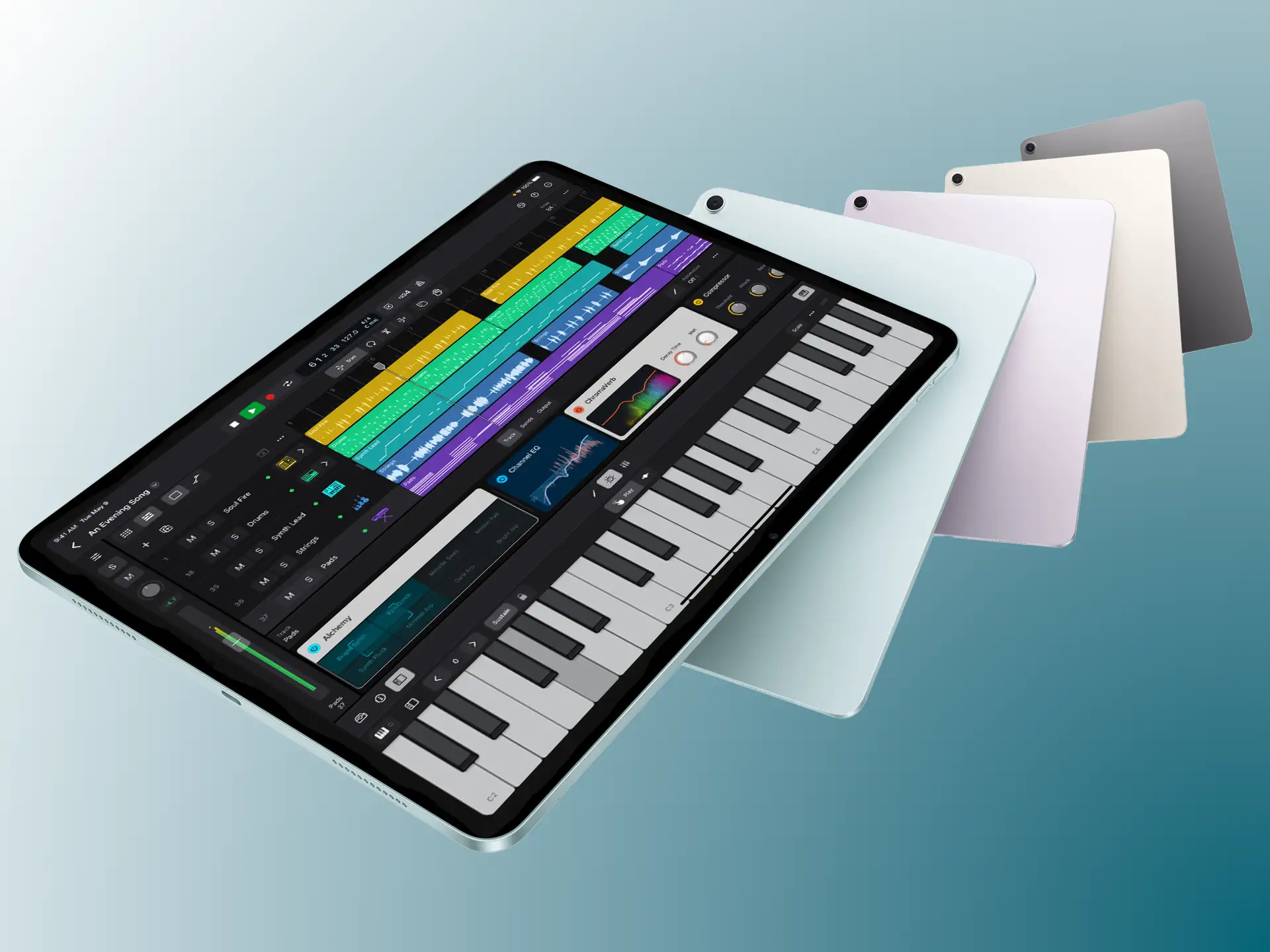
Apple has announced the latest generation iPad Air, now featuring the M4 chip, a significant upgrade for music creators working in portable studios. Announced on March 2, 2026, this update brings desktop-class processing power to the mid-range tablet line, positioning it as a serious contender for running complex DAWs and demanding AUv3 plugins. The headline improvements for musicians are the 12GB of unified memory—a 50% increase over the previous generation—and the M4’s 9-core GPU, which accelerates tasks like real-time waveform rendering and visual plugin interfaces.
For iPad music production, the M4 chip and increased memory bandwidth (120GB/s) translate directly to project stability. Producers can now run larger session templates with more virtual instruments and effects simultaneously without hitting performance ceilings. Apps like Logic Pro for iPad, Cubasis, or AUM will benefit from the 16-core Neural Engine’s 3x speed boost over M1 for AI-assisted tasks, such as stem splitting or smart tempo analysis. The addition of hardware-accelerated ray tracing, while marketed for gaming, also aids in rendering complex visualizers and 3D audio environments in apps like Moog’s Animoog or Visual Synthesizer 2 visual effects.
Connectivity sees major upgrades crucial for modern studios. The N1 wireless chip brings Wi-Fi 7 and Bluetooth 6 support, ensuring stable, low-latency connections to wireless MIDI controllers and fast file transfers via AirDrop. Cellular models now include Apple’s C1X modem with up to 50% faster data, useful for cloud collaboration or downloading samples on the go. The 13-inch model remains a favorite for producers who need screen real estate for detailed piano rolls and mixer views, while the 11-inch version suits ultra-portable sketching. Both sizes maintain support for Apple Pencil Pro (with squeeze and barrel roll) and the redesigned Magic Keyboard, which now includes a USB-C port for charging—a practical addition for studio desks.
For current iPad Air users with M1 or earlier models, the performance leap is substantial. The M4’s 4x faster 3D rendering with ray tracing hints at future-proofing for evolving music apps with advanced graphics. However, for producers already using iPad Pro with M2 or M3, the Air now closes much of the performance gap while remaining lighter and more affordable. The base storage remains 128GB, which is okay, but it’s not ideal for large sample libraries. The iPadOS 26 features, including the new windowing system and preview app, enhance multitasking between your DAW and reference tracks or notation apps. With the same starting price of $599 (11-inch) and $799 (13-inch), the iPad Air M4 offers a powerful, future-ready foundation for any mobile music studio.
Key features include:
- M4 Chip: 8-core CPU and 9-core GPU deliver up to 2.3x faster performance than M1, perfect for running multiple AUv3 plugins and large projects
- 12GB Unified Memory: 50% more RAM than previous generation, enabling complex session templates without system overload
- Enhanced Connectivity: Wi-Fi 7, Bluetooth 6, and optional 5G (C1X modem) for reliable wireless MIDI and cloud collaboration
- Display Options: 11-inch for portability, 13-inch for expansive mixer and piano roll views, both supporting Apple Pencil Pro
- iPadOS 26: New windowing system for multitasking between DAWs and reference tools, plus preview app for quick sketching
- Storage: Starts at 128GB, configurable up to 1TB for large sample libraries
- Accessory Support: Works with Magic Keyboard (now with USB-C pass-through) and Apple Pencil Pro for tactile control
App price: Starting at $599 (11-inch Wi-Fi), $799 (13-inch Wi-Fi), with cellular models $150 additional


Leave a Reply