
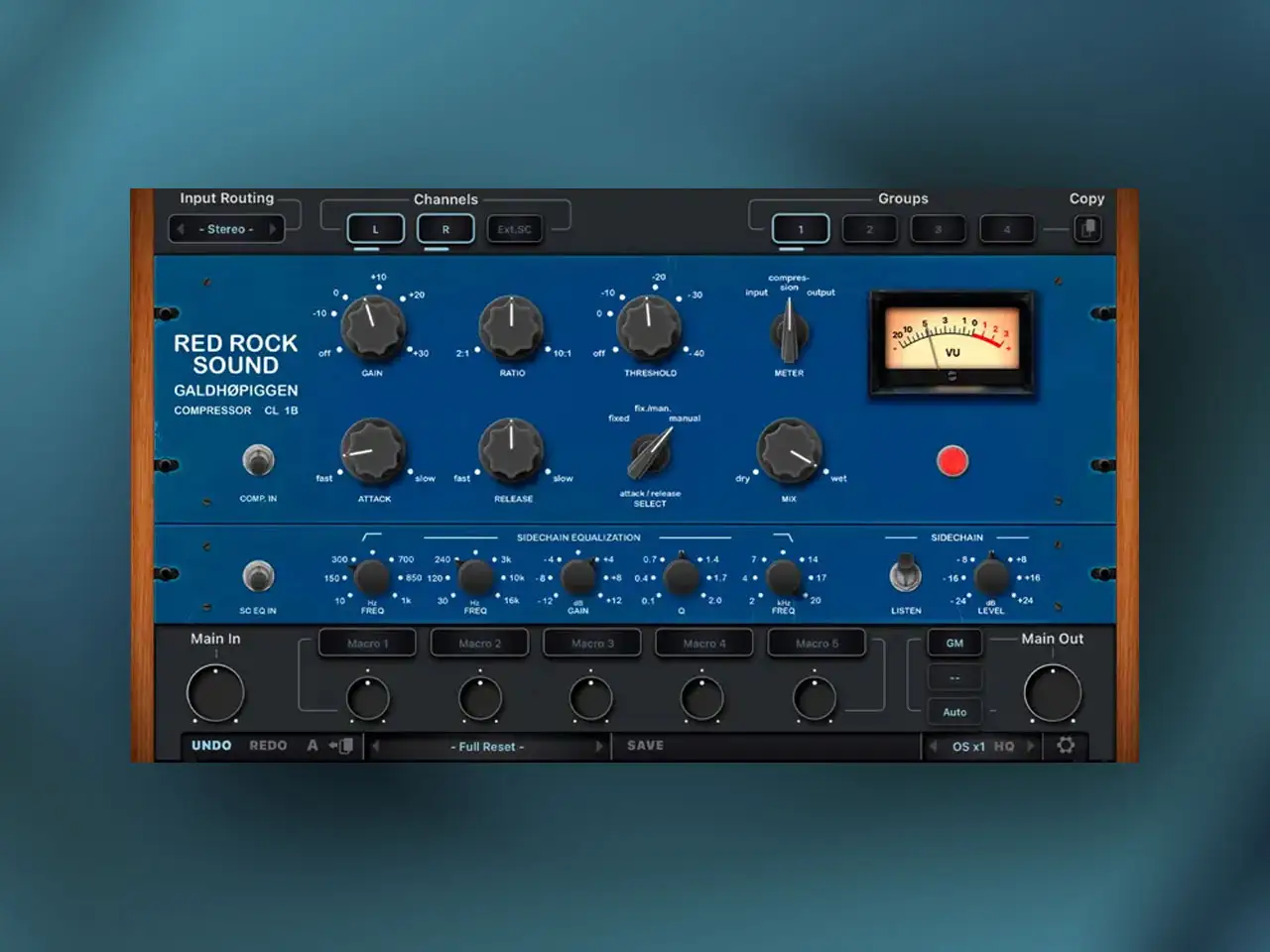
Red Rock Sound has been building one of the most consistent and underappreciated plugin catalogs on iOS since 2020. Their approach is methodical: take proven professional hardware references, model them accurately, and add the features that the original hardware could never have — M/S processing, upsampling, parallel mix, sidechain EQ. The Galdhøpiggen CL 1B follows that pattern precisely. Named after the highest mountain in Scandinavia, and marketed simply as a “modern vocal compressor,” it lines up in every meaningful way with the Tube-Tech CL 1B — a Danish optical compressor that has appeared on more professional vocal recordings than most engineers can count. Red Rock Sound does not confirm hardware references by name, following the same practice they use across their catalog, but the parameter set, the ratio range, the attack and release timing, the three-position A/R switch, and the overall operational logic are a near-exact match. The community on Loopy Pro came to the same conclusion within hours of release. For iOS producers who know what a CL 1B does on a vocal, this is a significant announcement. For those who do not, the short version is this: optical compressors are slower and smoother than VCA or FET designs, they do not grab transients aggressively, and the gain reduction curve feels more like the compressor is leaning into the signal than clamping it. That character is what makes opto-style compression so consistently flattering on vocals, acoustic instruments, and bass.
The compressor section covers everything you would expect from the reference. Threshold runs from +2dBU down to −40dBU — a wide range that covers both subtle program compression at the top and heavy limiting behavior at the bottom. Ratio is continuously variable from 2:1 to 10:1 on a logarithmic scale, so the musically useful range between 3:1 and 6:1 sits in the middle of the control sweep rather than crowded into one end. Makeup gain runs from Off to +30dB, positioned after the gain reduction circuit so it has no influence on how the threshold behaves. Attack is continuously variable from 0.5ms to 300ms, which is a notably wide range — the long end at 300ms is slow enough to let essentially the full transient through, which on a snare or vocal consonant produces a very different sound from a fast attack setting. Release runs from 0.05 seconds (50ms) all the way to 10 seconds, covering everything from tight program compression to slow, barely-perceptible gain riding. The three-position A/R Select switch changes how those manual controls interact with the signal. Fixed mode locks attack to 1ms and release to 50ms, bypassing both manual controls entirely — the fastest and most aggressive setting. Manual mode uses both manual knobs freely. Fix./Man. mode is the hybrid: attack stays at 1ms but release can be set manually, which gives you a fast catch on peaks with a user-defined decay. This three-way switch is one of the most practical things about a CL 1B-style compressor in real use: you can switch between fully automatic and manual behavior without touching the attack and release knobs. The VU meter has three display positions — Input, Compression (gain reduction), and Output — selectable during use, which gives you complete signal visibility across the whole chain from a single meter.
The sidechain section is well-implemented and worth covering in detail because it is the part that makes a vocal compressor genuinely useful rather than just sonically pleasant. The SC EQ sits at the very beginning of the detection path — before the signal splits into main and detection channels — so any frequency shaping you apply affects only what triggers the compressor, not the audio you hear. The practical use case is straightforward: cut the low frequencies in the sidechain and the compressor stops reacting to bass energy and low-mid thump, which means heavy low-end in a mix no longer pumps the compression into action on every bass hit. This is not a theoretical feature; it is one of the first things professional engineers set up on a vocal bus compressor in a track with prominent bass and drums. The Listen button lets you monitor the sidechain signal directly — a feature that matters when you are setting the SC EQ because it lets you hear exactly what the detector is responding to before committing. The Level slider adjusts the incoming sidechain trigger level independently of the main signal, which is useful when external sidechain routing produces a trigger signal that is significantly louder or softer than the compressed source. As an AUv3 inside Cubasis 3, the external sidechain routing connects via the standard AUv3 sidechain bus, which Cubasis supports natively. In AUM, the flexible routing matrix makes setting up the sidechain chain quick — bus the kick or bass track to the sidechain input and the compressor responds to the right trigger immediately.
The modern additions on top of the core compressor are all genuinely useful rather than just feature padding. The Mix knob (parallel compression, wet/dry blend) is arguably the most important of them. Heavy compression at 6:1 or higher with a slow attack blended back against the uncompressed dry signal produces the classic “New York compression” density — you get the sustain, glue, and level control of heavy compression while the dry transients remain intact, giving the result life and punch that fully wet compression alone cannot retain. The three processing modes — Stereo (Mono), Mid, and Side — allow the compressor to work on the full stereo field, the mono center image only, or the stereo sides only, which is particularly useful on a mix bus or stereo master chain where you want independent dynamic control over the center versus the edges of the stereo image. The 2x/4x/8x upsampling addresses aliasing artifacts that can occur at normal sample rates when the gain reduction circuit generates harmonics — at 8x upsampling those artifacts are pushed well above the audible range and filtered before downsampling back to the output rate. The macro controllers give you configurable front-panel shortcuts for the parameters you reach for most, the A/B comparison allows instant before/after switching between two different parameter states, and the built-in Gain Match compensates for the volume difference between bypassed and processed signal so level-matched comparisons actually tell you something about the compression rather than just confirming that louder sounds better.
The pricing model follows Red Rock Sound’s standard structure: a free download with a 5-minute demo period that resets each time you reload the plugin, and a one-time in-app purchase for the full unlimited version. The 5-minute window is enough time to understand the compressor’s character on a source before committing to a purchase, which is more useful than no trial at all, but it does mean you are racing a clock when evaluating it inside a complex session. Red Rock Sound has never compromised on the technical quality of their iOS releases — their EQ, dynamics, and channel strip plugins have been consistently well-engineered across years of releases — and the Galdhøpiggen CL 1B appears to continue that standard. For iOS producers who use compressors seriously and want a smooth optical-style vocal compressor with a proper sidechain EQ, M/S modes, and genuine parallel mix control, this is the first time that specific combination has been available on the platform at this level of implementation.
Key features:
- Optical-Style Vocal Compressor: Smooth, musical gain reduction modeled on a modern vocal compressor reference, with continuously variable Threshold (+2dBU to −40dBU), Ratio (2:1 to 10:1), Attack (0.5–300ms), and Release (0.05–10s)
- Three-Position A/R Select Switch: Fixed (1ms attack / 50ms release), Fix./Man. (fixed attack + manual release), and Manual (full independent control of both attack and release)
- Makeup Gain: Off to +30dB, positioned after the gain reduction circuit with no influence on threshold behavior
- Three-Position VU Meter: Switchable between Input level, Compression (gain reduction), and Output level display
- Mix Knob (Parallel Compression): Blend compressed and dry signal for “New York compression” density while retaining transient punch
- Sidechain EQ: Positioned first in the detection path — shapes what triggers the compressor without affecting the main audio signal. Includes SC EQ In toggle, Listen monitoring, and Level adjustment
- Stereo, Mid, and Side Modes: Apply compression independently to the full stereo signal, center mono image, or stereo sides
- 2x/4x/8x Upsampling: Pushes aliasing artifacts above the audible range for clean gain reduction at high settings
- Macro Controllers: Configurable front-panel shortcuts for fast access to most-used parameters
- A/B Comparison: Instant switching between two parameter states for before/after evaluation
- Built-In Gain Match: Level-compensates bypass comparisons so loudness difference does not skew the evaluation
- Undo/Redo and Scalable GUI
- Universal AUv3 and standalone on iPhone and iPad
App price: Free (5-minute demo, reloadable).
In-app purchases: $8.99 Full Version Unlock
Original release: June 8, 2026 | Latest update: June 8, 2026


