
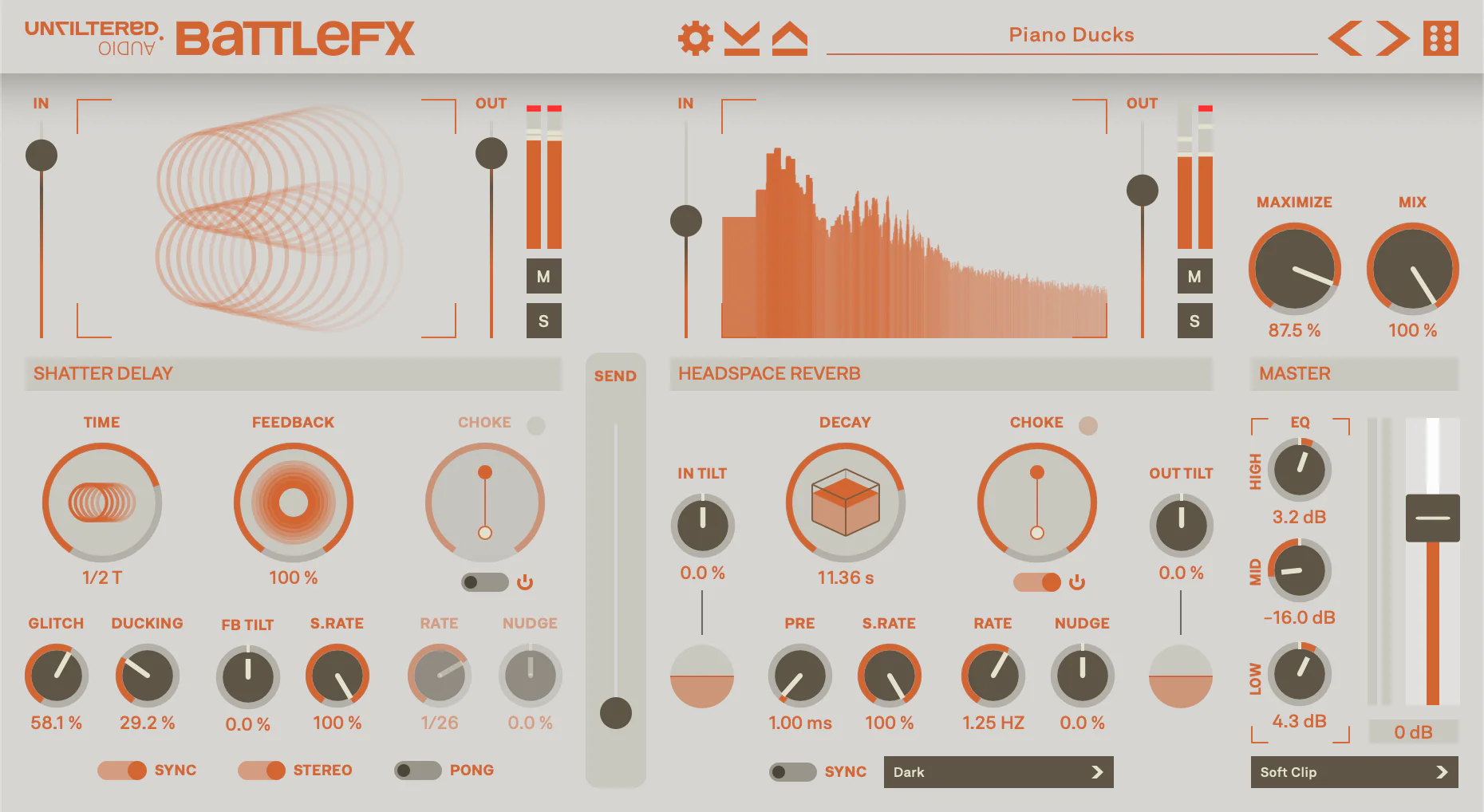
Unfiltered Audio has a reputation for making effects that behave in ways standard processors do not. Their Battalion drum synthesizer built a following partly on the strength of its effects section — specifically the Shatter Delay and Headspace Reverb, which gave drum patterns a textural depth and controlled unpredictability that most drum machines cannot produce. Battalion users had been asking for those effects as a standalone plugin for some time. BattleFX is the answer, and it landed on iOS this week as a free AUv3. This is not a stripped-down preview or a teaser tool. The entire effects chain from Battalion is here — Shatter Delay, Headspace Reverb, 3-band EQ, Maximize, and multimode distortion — expanded with an automatic choke system that did not exist in the original drum synth. The desktop version launched in May; the iOS release follows now, and the price on both platforms is zero. No in-app purchases, no subscription, no catch. Unfiltered Audio describes it as their first truly free plugin, and the iOS community at Loopy Pro called the DSP quality “top tier” immediately on release.
The Shatter Delay is the more unusual of the two effects and the one that takes longer to fully understand. It is not a standard delay. The core of it is a granular buffer — delay time changes are handled through the granular engine rather than pitch-shifting the delayed audio, which means you can sweep the delay time during playback without any of the Doppler artifacts or pitch slides that a conventional delay produces when you move the time control. That alone makes it a different instrument to work with. The Glitch parameter adds smooth, random Brownian motion to the delay time independently — a slow, continuous drift that keeps the delay from settling into a perfectly locked pattern even when the tempo is synced. With Active Stereo engaged, Glitch applies separately to the left and right channels, which produces a slowly wandering stereo spread on the repeats. Sample-rate reduction degrades the delay’s sonic character progressively, from clean to heavily artifacted, which combined with the granular buffer produces textures that sit between a standard delay and a sampler malfunction. Feedback has its own tilt filter for frequency shaping the repeat chain, and Ducking, Pong stereo mode, and individual Mix, Solo, and Mute controls round out the section. This is a delay that rewards deliberate exploration rather than preset browsing.
The Headspace Reverb is an updated version of the algorithm from Unfiltered Audio’s SILO granulator. Ten switchable modes — Dark, Rusty, Saturated, Glitter, Crayon, Bokeh, Flare, Flutter, Hollow, and Austere — cover ground from dense ambient spaces to glitchy, artifact-heavy processing that does not resemble conventional reverb in any obvious way. Mode selection is not just a preset picker; each mode uses a different underlying algorithm, so switching between Bokeh and Flutter produces fundamentally different behavior rather than tonal variation on the same decay curve. Input and Output Tilt controls sit at either end of the reverb chain — shaping the frequency content entering the reverb and the frequency balance of what you hear coming out, independently. Syncable pre-delay and decay give standard timing control, and the same sample-rate reduction from the delay section applies here too, turning the reverb from pristine to worn and heavily degraded at lower settings. For the master section, the Maximize control has become one of the signature sounds of Battalion — it brings a dense, saturated loudness to whatever passes through it, and with the 3-band EQ and multimode distortion available alongside it, the combined output can move from clean processing to highly colored character depending on how hard you push the chain. As an AUv3 inside AUM, you can run BattleFX as a send effect on any channel in the session — which is exactly how it was used inside Battalion. In Loopy Pro, it routes cleanly as an effect on any track or group bus, and the Solo and Mute controls per section make it easy to evaluate what each block is contributing in a live context.
The auto-choke system is the addition that makes BattleFX more than a simple Battalion FX extract. In Battalion, the choke function cuts the delay and reverb buffers when a specific drum pad is hit — you sidechain a crash or kick, and those hits clear the effect tail. That workflow requires the drum synth context to make sense. In BattleFX, standing alone on any track, the choke needed a different trigger system. The solution is a rhythmic sequencer with a Euclidean pattern generator. Euclidean rhythms distribute a specified number of events as evenly as possible across a given number of steps — the same mathematical principle behind many African and Middle Eastern traditional rhythm patterns, and a common algorithm in step sequencers for generating non-repeating, musically grounded rhythms. Applied to buffer choking, it creates periodic cuts in the delay and reverb tails at intervals that feel rhythmically coherent without being mechanically regular. The choke can run tempo-synced to your host or free-running at its own rate, operates independently on delay and reverb, and can nudge slightly ahead or behind the beat in either direction. The practical result is a delay and reverb that duck, stutter, and breathe in patterns that sync loosely with your track’s groove without exactly matching any single beat — which produces the kind of organic movement that static on/off gating cannot replicate. Loopy Pro community users noted the effect works particularly well with noisy or transient-heavy inputs with the Maximize knob raised, because the choke cuts into a sustained, saturated signal rather than a clean one.
The interface offers customizable themes — light, dark, color, no-color, and a randomized option — which is a small but genuinely useful feature when you are working across different screen brightness levels and lighting environments on iPad. The plugin is universal, covering iPhone and iPad from iOS 12.0 onward. For any producer already using Battalion on iOS, the arguments for downloading BattleFX are obvious. For producers who have never used Battalion, BattleFX is a reasonable introduction to what makes Unfiltered Audio’s approach to effects design distinctive — the combination of high-quality core algorithms with parameters that actively encourage non-standard results. The Shatter Delay and Headspace Reverb are not tools that have obvious equivalents elsewhere on the iOS App Store, free or otherwise. The auto-choke Euclidean system has no equivalent at any price on mobile. Getting all of that for nothing is an unusually generous release from a developer whose paid work is worth paying for.
Key features:
- Shatter Delay: Granular buffer-based delay with artifact-free time sweeping, Glitch (Brownian motion drift), Active Stereo independent L/R glitch, sample-rate degradation, feedback tilt filter, Ducking, and Pong stereo mode
- Headspace Reverb: Ten distinct algorithm modes (Dark, Rusty, Saturated, Glitter, Crayon, Bokeh, Flare, Flutter, Hollow, Austere), Input and Output Tilt shaping, syncable pre-delay and decay, and sample-rate degradation for heavy artifact textures
- Auto-Choke System with Euclidean Patterns: Rhythmically chokes delay and reverb buffers at mathematically distributed intervals — tempo-synced or free-running, independently on each effect, with timing nudge for off-grid placement
- Master Section: Maximize (Battalion’s signature loudness/saturation stage), 3-band EQ, and multimode distortion
- Solo and Mute per Section: Evaluate each effect block independently or combine them freely
- Customizable Interface Themes: Light, dark, color, no-color, and randomized visual options
- Universal AUv3 and standalone on iPhone and iPad — iOS 12.0 minimum
App price: Free. No in-app purchases. No subscription.
Original iOS release: June 2026 | Desktop release: May 15, 2026


