
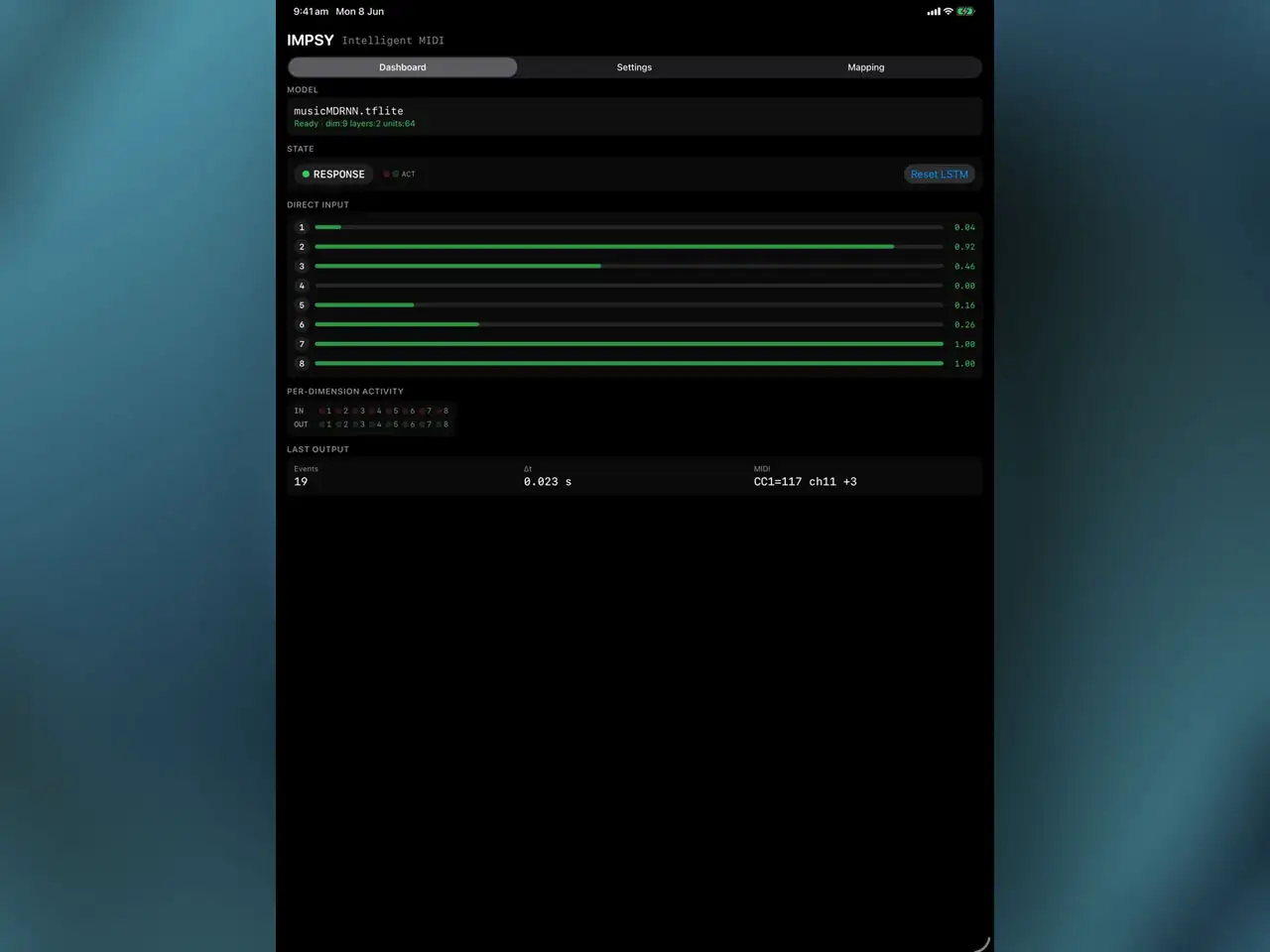
Most “AI” features bolted onto music apps in 2026 amount to a mastering button or a stem separator. IMPSY is a different animal entirely, and it comes from a developer who has been working on this specific problem for almost a decade. IMPSY — the Interactive Musical Prediction SYstem — is an AUv3 MIDI Processor that listens to whatever you play and improvises a response back to you, in real time, entirely on-device. No cloud, no API calls, no account. It runs a small neural network called a Mixture Density Recurrent Neural Network (MDRNN), trained on recorded musical performances, and uses it to predict what should happen next — both which notes or control values come next, and when they should arrive. The result, when it works, feels less like a generative tool and more like a duet partner with unpredictable but musically coherent timing.
The plugin itself has no audio inputs or outputs — it is purely a MIDI effect, sitting between your controller and your synth. Every note, CC, or pitch-bend message you send becomes input to the model, and IMPSY’s output is a stream of MIDI events you route to any instrument. Four parameters shape the character of the response. Threshold sets how long IMPSY waits between hearing you and replying, from a snappy 0.1 seconds up to a patient 10 seconds. Sigma Temp controls how far the model strays from what it learned in terms of pitch and control values — low values stay close to its training, high values get weird fast. Pi Temp is subtler: it governs which musical “idea” the model picks from its internal mixture, affecting motif selection rather than note-level jitter. Timescale speeds up or slows down the whole response without retraining anything. A MIDI Thru toggle and separate dedup windows for notes and CCs round out the controls — useful for avoiding doubled notes when your controller is already routed to the same synth.
As an AUv3 MIDI Processor (the technical term is aumi), IMPSY loads inside AUM, AudioBus, Cubasis, and Logic Pro for iPad‘s MIDI FX slot, as well as Loopy Pro, Drambo, apeMatrix, BeatMaker 3, and Auria Pro on iOS. On macOS it loads in Logic Pro and MainStage on Apple Silicon (M1 or later — Intel Macs are not supported, since the TensorFlow Lite runtime the model depends on doesn’t currently ship a stable Intel build). Here’s the honest caveat that the developer states plainly rather than burying: GarageBand does not host AUv3 MIDI Processors at all, on iOS or macOS, so IMPSY simply won’t appear there — that’s an Apple-side limitation that applies to every aumi plugin, not something specific to this app. Ableton Live has the same gap as a plugin host, but IMPSY’s standalone app publishes Core MIDI virtual ports — IMPSY In and IMPSY Out — that Live can route through directly, so the workaround is running the standalone app alongside your DAW rather than loading a plugin inside it.
That standalone mode is worth dwelling on, because it makes IMPSY usable with zero DAW at all. Plug in a USB or Bluetooth MIDI controller, open the app, and IMPSY connects directly to the hardware and starts responding — the on-screen sliders work too if you’d rather play from the touchscreen. The interface itself is the same three screens — Dashboard, Settings, and Mapping — whether you’re on iPhone, iPad, or Mac, scaled appropriately for each. The Mapping screen is where IMPSY gets genuinely deep: each dimension of the loaded model (nine by default) can be assigned independently, for input and output, to any MIDI note, CC, or pitch-bend on any channel. Mappings save with your session and export as TOML files compatible with IMPSY’s open-source Python research toolkit, which is the same toolkit Charles Martin’s team at the ANU School of Computing uses to train new models. If you want to go further than the default 9-dimensional model — which was trained for general musical interaction — you can train your own .tflite model on your own recorded performances (IMPSY’s session logging captures performances in the format the training scripts expect) and load it via Files on iOS or Finder on Mac.
Martin is also the developer behind PhaseRings, an AUv3 ring-modulation synth that has a following among iOS sound designers, so IMPSY isn’t a side project from someone dabbling in iOS development — it’s a research tool, built by someone who already understands what makes an AUv3 plugin usable in a real session, repackaged as a free release. At 19.2MB it’s a reasonable size for an app that ships an on-device neural network, and Apple’s privacy label confirms zero data collection — no network access of any kind, which also means it works on a plane or anywhere else off the grid. Whether IMPSY earns a permanent slot in your chain depends on what kind of producer you are. If “happy accidents” and call-and-response improvisation are part of how you write, this is a genuinely novel tool at a genuinely unbeatable price. If you need deterministic, repeatable output, the Sigma Temp and Pi Temp knobs exist specifically so you can dial the randomness down — but the appeal here is the surprise, not the control.
Key features:
- On-Device MDRNN: A Mixture Density Recurrent Neural Network listens to incoming MIDI and predicts both the content and timing of its response — no network or cloud processing required
- Four Response Parameters: Threshold (reply timing, 0.1–10s), Sigma Temp (pitch/value randomness, 0.001–2.0), Pi Temp (motif-selection randomness, 0.1–5.0), and Timescale (response speed, 0.1–4.0×)
- MIDI Thru and Dedup: Optional pass-through of your own playing, plus separate note and CC/pitch-bend dedup windows (0–500ms) to suppress repeated values
- AUv3 MIDI Processor: Loads in AUM, AudioBus, Cubasis, Logic Pro for iPad, Loopy Pro, Drambo, apeMatrix, BeatMaker 3, and Auria Pro — no audio I/O, MIDI in and out only
- Standalone Core MIDI Ports: Runs without a DAW — connects directly to hardware controllers via the always-available
IMPSY In/IMPSY Outvirtual ports - Custom Model Loading: Ships with a default 9-dimensional model; load any
.tflitemodel trained with the open-source IMPSY research toolkit - Flexible Mapping: Each model dimension maps independently — input and output — to any MIDI note, CC, or pitch-bend on any channel
- TOML Import/Export and Session Logging: Save and share mapping configurations, and record performances in a format usable to train new models
- VoiceOver and Dynamic Type Support: Every control is labeled and adjustable via VoiceOver, with status shown as text rather than color alone
- Universal on iPhone, iPad, and Apple Silicon Mac (M1 or later). No network access, no telemetry, no accounts. Requires iOS 17 / macOS 14.
App price: Free. No in-app purchases.
Original release: June 11, 2026 | Latest update: June 11, 2026


Leave a Reply